Gröbner free methods and their applications
Barcelona, April 13-15 2026

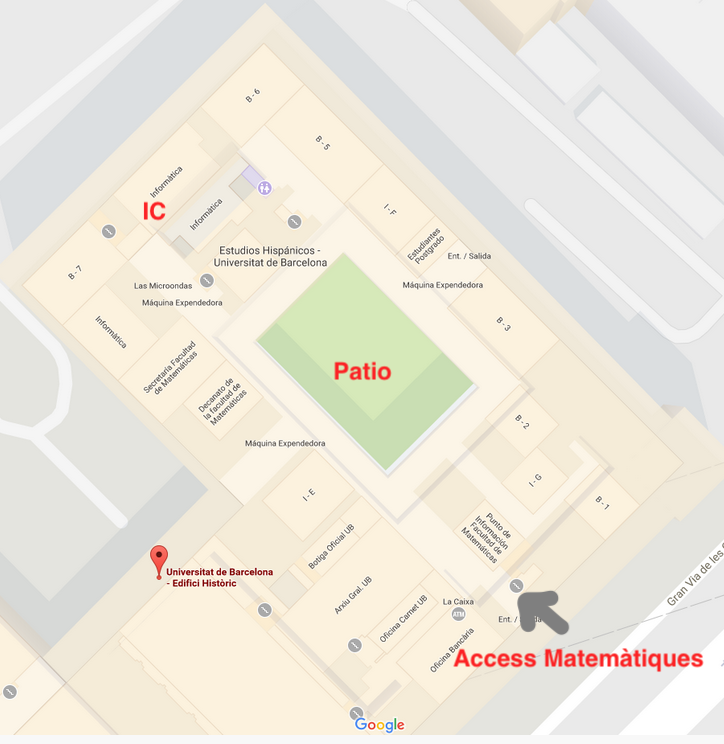
Aula IC Facultat de Matemàtiques i Informàtica, University of Barcelona
Gran Via 585, Barcelona

This is a series of anual events following those organized in Bari 2025, and La Rioja 2024.
The goal of these meetings is to bring together researchers working on alternative methods for solving polynomial systems. While Gröbner bases have been highly influential, Buchberger’s algorithm can be computationally heavy when used by default. Gröbner-free approaches instead rely on linear algebra and combinatorics to obtain the same results more efficiently, reserving Gröbner basis computations for when they are truly needed.
Topics include but are not limited to
* Combinatorial methods for monomial and polynomial ideals
* Improvements and generalizations of Gröbner-related algorithms such as Janet’s and Macaulay’s.
* Algorithms for doing computations in subalgebras • 0-dimensional solving and bonding problems
* Applications in coding theory, cryptography, reverse engineering, biology, and algebraic statistics
As in the previous editions, our timing will be sufficiently relaxed to allow participants to discuss and work together.
Information about lodging in Barcelona can be found here.
Keynote Speakers
Gianira Alfarano, Université de Rennes
Skew-polynomial rings and algebraic coding theory
Cyclic codes are among the most extensively studied families of block codes in classical coding theory, as they provide the algebraic framework for the construction of important code families such as Reed–Solomon and BCH codes. A natural generalization of these codes is given by the so-called skew-cyclic codes. These codes are based on skew-polynomial rings in one indeterminate. The key difference from the commutative polynomial case is that, in the skew setting, the indeterminate does not commute with its coefficients. In this talk, we will discuss how the theory of skew-polynomial rings can be applied to algebraic coding theory. In particular, we will present some recent results concerning the minimum distance of skew-cyclic codes with respect to the Hamming, rank, and sum-rank metrics. The presentation is based on the foundational work on skew-polynomial rings by Ore (1933) and by Lam and Leroy (1988–2012), as well as on the theory of skew-cyclic codes developed by Boucher, Ulmer, and collaborators (2007–2014), and on joint works with Lobillo, Neri, and Wachter-Zeh.
Roser Homs, Universitat Politècnica de Catalunya
Markov basis and graphical models
A graphical model is a collection of probability distributions where the nodes of a graph represent random variables and the edges encode their statistical dependencies. In algebraic statistics, we are interested in the polynomial equations defining these models to facilitate parameter identifiability, model selection, or causal discovery. From an algebraic perspective, these models are semialgebraic sets. Given a parametrization, the objective is to find the vanishing ideal of the model's Zariski closure.
If the parametrization is monomial, the corresponding toric ideal is generated by a set of binomials known as a Markov basis. Originally developed by Diaconis and Sturmfels for conditional sampling, a Markov basis consists of binomial "moves" that allow for connectivity within a fiber. In this talk, we introduce Markov bases, discuss their relationship to Gröbner bases, and explore their interpretation as combinatorial moves. We will demonstrate how to prove that a generating set is a Markov basis using tableau representations for linear non-Gaussian graphical models whose underlying graphs are trees. This is joint work with Carlos Améndola, Mathias Drton, Alexandros Grosdos, and Elina Robeva.
Submission instructions and deadlines
If you are interested in giving a 30 minutes presentation, please submit an abstract (3 pages maximum) through Easychair.
The accepted abstracts will be distributed at the conference. Some of them, on decision of the Organizing Committee, will be allowed to submit a complete paper which will be published in a special issue of Journal AAECC, after a referee evaluation according to the standard of the Journal.
Deadline for submissions: February 28th 2026
Schedule
Monday 13/04
Chair: Carlos D'Andrea
09:00-09:30 Registration
09:30-10:30 Invited talk: Gianira Alfarano
10:30-11:00 Coffee Break
Contributed Talks
11:00-11:30 Matías Bender: Solving bihomogeneous polynomial systems with a zero-dimensional projection
11:40-12:10 Carles Checa: An effective criterion for multiple positive solutions of vertically parametrized polynomial systems
12:20-12:50 Sofia Bovero: Homogeneous Border Bases on infinite order ideals
13:00-13:30 Oriol Reig: The Waring rank problem and algorithms
13:30-15:00 Lunch
15:00-18:00 Working Session: Gianira Alfarano
Chair: Samuel Lundqvist
Goal: Construct optimal codes in the rank metric using skew polynomials.
Skew cyclic codes are a non-commutative generalization of classical cyclic codes, built using skew polynomials over a field extension. Their structure is determined by a defining set, which controls both the dimension and the rank distance of the code.
In https://doi.org/10.1016/j.ffa.2020.101772, we have constructed Maximum Rank Distance (MRD) skew cyclic codes by choosing defining sets with a very regular structure (an arithmetic progression), which guarantees optimal rank distance.
The question is whether one can construct MRD codes from more general defining sets, where this structure is less rigid but still sufficiently controlled. Such new constructions are known not to exist when the degree extension is prime, while in the general case the problem remains open.
Tuesday 14/04
Chair: Fatemeh Mohammadi
09:30-10:30 Invited talk: Roser Homs
10:30-11:00 Coffee Break
Contributed Talks
11:00-11:30 Francesca Cioffi: Counting finite O-sequences of a given multiplicity and experimental estimations of their growth
11:40-12:10 Danai Deligeorgaki: Combinatorial and algebraic perspectives on the marginal independence structure of Bayesian networks
12:20-12:50 Matthias Orth: Generalized Catalan numbers and Groebner bases
13:00-13:30 Victor Ufnarovski: Generic and almost monomial subalgebras
13:30-15:00 Lunch
15:00-18:00 Working Session: Graphical models with toric vanishing ideals - Roser Homs
Chair: Teo Mora
Goal: Find graphs (besides trees) such that the vanishing ideal of the corresponding graphical model is toric.
In the case of trees, linear non-Gaussian graphical models have toric vanishing ideals (ArXiv 2112.10875). In ArXiv 2105.13357, Misra and Sullivant provide criteria to construct graphs with Gaussian graphical models with toric vanishing ideals. We will start by studying small examples provided by Misra and Sullivant, use algebraic software to compute the vanishing ideal in the analogous non-Gaussian model and use tools to check toricity of such ideals.
20.00-22.00 Conference dinner: Restaurant Can Ros, Carrer d'Emília Llorca Martín, 7, in the Barceloneta neighbourhood.
Wednesday 15/04
Chair: Michela Ceria
Contributed talks
10:00-10:30 Filip Jonsson Kling: The Gröbner basis for powers of a general linear form in a monomial complete intersection
/span>
10:40-11:10 Barbara Betti: Eigenvalue and Homotopy Algorithms Using Khovanskii Bases
11:10-11:40 Coffee Break
Contributed talks
11:40-12:10 Emily Berghofer: Constructing Koszul Filtrations: Part 1
12:20-12:50 Lisa Nicklasson: Constructing Koszul filtrations: Part 2
13:00-15:00 Lunch
15:00-18:00 Working Session: Koszul filtrations for G-quadratic toric ideals
- Lisa Nicklasson
Chair: Per Bäck
Goal: Investigate a conjecture on Koszul filtrations of G-quadratic toric ideals posed in arXiv:2602.06490.
The conjecture states that any toric ideal with a quadratic Gröbner basis has a monomial Koszul filtration, a property which does indeed hold in the case of the DegRevLex term order. The idea for the workshop is to collect examples of toric ideals from the literature which has quadratic Gröbner bases w.r.t. other term orders, and test whether they satisfy the conjecture. Given that the answer is positive, what does the Koszul filtration look like? Further, we may explore the opposite direction: Given a monomial Koszul filtration, can we construct a quadratic Gröbner basis for the given toric ideal?
Registration
Registration is already closed. If you want to participate in the workshop and have not registered yet, conctact the organizers.
List of registed participants
Organizing Committee