
Índice de contenido
1. Introduction
Data management in a research project is a fundamental and crucial aspect to ensure the quality and reliability of the results obtained. In the information age, where the amount of data generated is overwhelming, it is essential to establish a plan for the collection, storage and processing of the data generated during the research.
It is important to note that, within the framework of this project, research data (datasets) must be made available to the public following the guidelines set by the Spanish Ministry of Science and Innovation. In this way, the research data become one more result of the project, just like an article or a scientific communication.
To facilitate their management and comply with transparency and accessibility standards, guidelines and illustrative examples are provided to help researchers in the process. In addition, for the preservation of data over time, the use of open file formats is recommended to allow long-term preservation.
2. What is research data?
Research data is the body of information and evidence collected during a scientific research process. These data may include observations, measurements, surveys, interviews, images, audio files and other types of records that support the results and conclusions of a study.

Source: Podnation
3. Why give access to data?
Facilitating access to research data allows to comply with the principles of being: findable, accessible, interoperable and reusable (Findable, Accessible, Interoperable and Reusable).
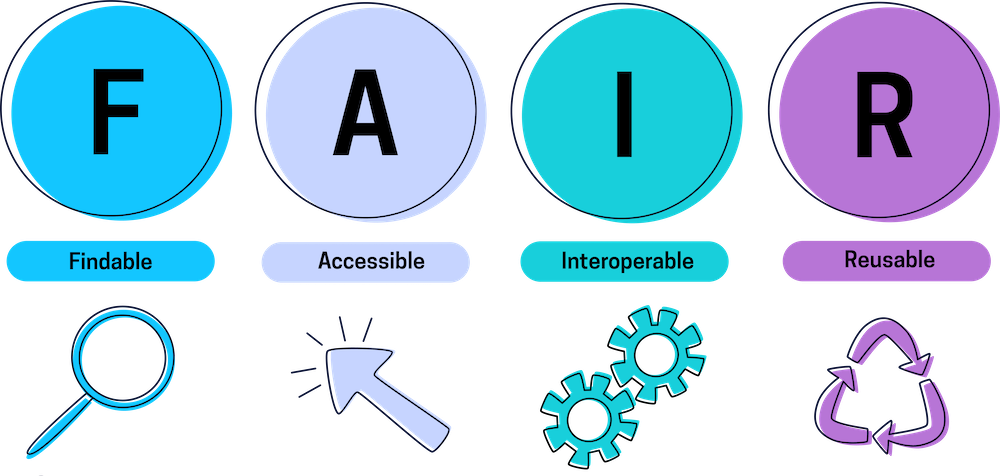
The implementation of FAIR principles in data management promotes transparency, collaboration and the positive impact of scientific research.
4. How is research data managed?
Research data management is an essential process that must be planned from the beginning of any research project. This careful planning ensures that the data generated during the research are properly organized, documented and stored, thus facilitating their access and reuse both by the researchers themselves and by other interested parties in the future.

Source: Biblioteca-CRAI UPO
5. How is access to data provided?
The most common types of data in the project are:
- Text (e.g., interviews)
- Tabulated data in a spreadsheet (e.g., observations).
The following are the steps to follow to facilitate access to the data.
5.1 Preparing data
The data should be organized, documented and cleaned to ensure that they are ready for sharing. It is advisable to create the README.txt file that accompanies each dataset to provide the details of the research and data collection.
Several customizable templates are provided below:
1. Tabulated data template
2. README.txt template
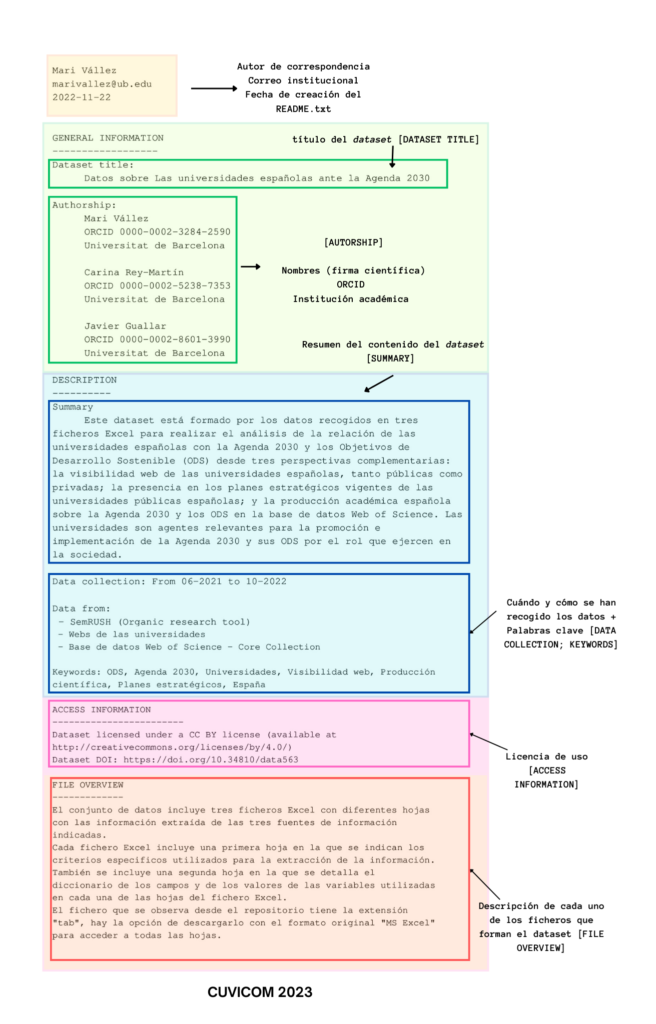
Source: CUVICOM
5.2 Depositing data on a platform
[Sección pendiente de desarrollar]