
|
Geografia d'Europa |
Laura Lonza and Hector Hernández, IPTS
Issue: The Urban Mobility Agenda has broadened its scope from just transport issues to its present holistic approach including social, economic and environmental aspects of mobility. That is why urban mobility measures should be systematically and comprehensively assessed, with attention given to ‘impacts’ rather than ‘outputs’. Moreover, the evaluation process needs to be transparent.
Relevance: Within the broad goal of sustainable
development, urban policy-makers need sound evaluation frameworks to help
them balance conflicting policy objectives such as fostering economic development
and minimizing environmental stress. This need is particularly felt when
tackling urban mobility, where dynamic information patterns are required
to ensure monitoring of progress and to keep policy-makers constantly up-to-date.
Introduction
Sustainable Development
has permeated policy-making at all levels1.
The application of the sustainable development concept to urban areas is
essential for a number of reasons. In economic terms, these reasons include
the fact that cities are the engines of growth and centres of power. In
environmental terms, urban areas pose serious challenges and place increasingly
heavy burdens on the global environment (e.g. in terms of climate change),
particularly in relation to the balanced use of resources and disposal
of pollutants. And in social terms, urban areas shape lifestyles and are
the prime reactors to change. Moreover, the phenomenon of urbanization
is a growing worldwide, making the issues it raises yet more pressing.
Mobility in urban areas is closely linked to the economic, environmental and social aspects of life in cities and contributes to their role as vital centres of activity
Mobility in urban areas is closely linked to the economic, environmental and social aspects of life in cities and it is part of what enables them to be vital centres of activity. Moving towards sustainable urban mobility means mitigating the negative externalities of transport, such as air and noise pollution. It also calls for resource conservation, reducing energy consumption, easing congestion and resolving equity concerns.
The first part of the article presents an analytical framework to appraise sustainable mobility policy measures in urban areas. Existing research trends and results point in the direction of cross-sector2 integration as the solution to the sustainability riddle.
A set of criteria derived from the application of the analytical framework is presented in the second part. Strengths and weaknesses of specific measures for improved urban mobility are identified. Good-practice examples are taken from a range of urban mobility policy and technical measures to illustrate the criteria outlined.
A framework for analysis
An analytical framework is a useful way of drawing attention
to the public policy system as a whole and to the need to see cross-sector
issues as being characteristic of the policy system. Better handling of
cross-sector issues is not just a matter of better tools and techniques,
although they have their place, but of a fundamentally different approach
to government. It seems that effective handling of cross-sector issues
requires an impacts-driven approach to public policy, where structures,
systems and processes are designed around the policy problem to be solved
rather than having the problem defined in terms of the existing system.
Moreover, a framework for analysis is useful in that it helps to identify
limiting factors and critical areas for intervention, define priorities,
and provide a balanced view of the impacts of policy actions within a specific
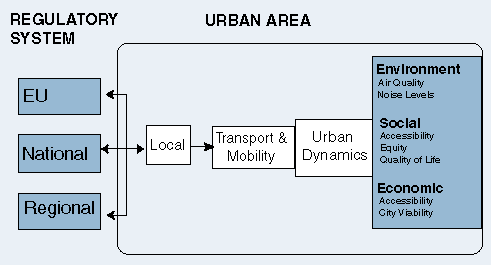
urban context. A schematic representation of an Analytical Framework for
urban mobility is presented in Figure 1, showing the main areas and levels
of competence concerned, together with their interactions.
Effective handling of cross-sector issues requires an impacts-driven approach to public policy, where structures, systems and processes are designed around the policy problem to be solved rather than having the problem defined in terms of the existing system
Figure 1. Analytical Framework for Urban Mobility
Because each urban area is different, there can be no
single quick-fix solution. The framework for analysis proposed here aims
to identify and characterize drawbacks and success factors for evaluation.
An inductive approach has been adopted, using indicators providing information
so as to take into account the unique characteristics of each urban area.
The framework for analysis proposed here aims to identify and characterize drawbacks and success factors for evaluation
From the analytical framework to indicators
The assessment of transport policies and their impacts on sustainability implies the need to represent complex phenomena. A set of indicators based on quantifiable and available information can provide concise information highlighting what is happening in a large system, giving the opportunity to compare across sites and a useful and relatively quick way of displaying reality. Indeed, provided a number of criteria are respected, indicators can offer a reliable representation of systems.
Indicators make it possible to present results to non-technical
experts such as policy-makers and citizens in a ‘catchy’ way, as well as
allowing comparisons. Sound criteria must be considered when selecting
indicators: (1) close correlation to the objectives set in order to achieve
sustainable mobility; (2) quantitative and monitored data; (3) available
—or easily obtainable— and reliable information; (4) close correlation
with policy agenda and organizational schemes; (5) transparency, and avoidance
of biases in favour of specific interests.
The area of urban dynamics covered by the selected indicators includes the environment, land-use, city economic profile, and information about the organizational aspects of the public authority at the local level with regard to transport and mobility
A set of indicators has been developed by analysing relevant sources in this area. The area of urban dynamics covered by the selected indicators includes the environment, land-use, city economic profile, and information about the organizational aspects of the public authority at the local level with regard to transport and mobility.
Table 1. Selected Indicators
Representing Urban Mobility
| Needs | Main Areas Impacted by Transport | Quantitative Indicators |
| Social | Accessibility | Urban Land Cover |
| Built-up Area | ||
| Mobility | Open Areas | |
| Derelict Areas | ||
| Equity | Urban Renewal Areas | |
| Area Dedicated to Transportation Network | ||
| Economic | Economic Activity (Enabler) | Mono-functional Areas |
| Land-use Distribution by Housing Units | ||
| Traffic Density (Congestion) | Proximity to Urban Green Spaces | |
| Urban Population Density | ||
| Air Quality | Employment Distribution in Productive Sectors/ Weight of Small and Medium Enterprises (SMEs) | |
| Unemployment | ||
| Acoustic Quality | Employment of People with Reduced Mobility | |
| Concentration of local pollutants (e.g. SO2, NOx, CO, PM, Lead, Benzene) | ||
| Spatial Development (including Accessibility of Green Spaces) | Exposure to Noise (inhabitant per time period) | |
| Environmental | Car Ownership | |
| Rational Use of Materials and Energy | Modal Split | |
| Traffic Volumes/ Average Vehicle Speed | ||
| Technical Safety and Personal Security in Vehicles and Transport Infrastructure | Commuting Patterns | |
| Visual Impact | ||
| Preservation of Cultural Heritage |
These indicators were subsequently grouped according to the three dimensions of sustainable development, namely social, economic and environmental values. These latter feed, in turn, into the urban system and bring us back to the analytical framework (see Figure 1). Although mobility-related measures may mainly affect the Transport and Mobility Component of the Urban System, their impacts are pervasive. Specifically, it is interesting to see how the regulatory framework is implicated in the process at the local level but also at the regional, national and EU level.
Using the analytical framework: relevant criteria
Despite the need to substitute functional separations with a holistic approach in urban policies, in-depth analysis is still crucial in order to establish the links between sectors of intervention and areas of impact. Therefore, maintaining a specific focus on mobility is not contradictory. Additionally, the diversity of urban realities makes it highly desirable —although extremely difficult— to transfer experiences.
To achieve sustainable mobility in urban areas, many trade-offs must be faced. It is up to local decision-makers to recognize shortcomings and engineer them out of the urban mobility system. Therefore success depends on an integrated approach to closely related policy areas.
This is not an easy or straightforward task. Evaluating
whether needs are being taken into account in a balanced way has to reflect
a number of criteria going beyond the sectoral approach adopted so far.
The process of moving from the vision of an integrated approach to its
actual achievement is as yet far from being achieved. A number of factors
have been identified as being important for success when analysing urban
mobility measures with the proposed framework, such as long-term evaluation,
coordination of transport and spatial development, and competence levels.
These are discussed below.
A number of factors have been identified as being important for success when analysing urban mobility measures with the proposed framework, such as long-term evaluation, coordination of transport and spatial development, and competence levels
Long-term evaluation using indicators
To evaluate the implementation of any given set of mobility measures correctly, it is crucial to define objectives, targets and indicators clearly. Nonetheless, dynamism must be given an appropriate place. No policies are carved in stone. The purpose of defining objectives, targets and indicators is to help monitor changes and, where changes are not achieved, to revise those elements which have not worked as initially foreseen.
Box 1: The Strasbourg Experience
|
The
Urban Community of Strasbourg adopted in 1989 a far-reaching policy to
modify transport patterns and urban space usage. Referring to the analytical
framework, intervention on the Transport & Mobility component took
place affecting Urban Dynamics. The overall goal was split into three objectives:
reducing private car traffic (accounting for 72.5% of urban transport in
1989); increasing public transport use (11% of urban transport in 1989);
and, if possible, increasing the use of bicycles (approximately 12% in
1989). Acceptability was checked via a household survey in 1989.
In
1995, public transport services (trams and buses) were meeting the identified
targets of a 30% increase compared to 1992 with a 32% increase in passengers,
around 50% of them using park-and-ride facilities, which proves the popularity
of the mix of measures. In 1995, traffic entering the wider city centre
had decreased by 17% compared to 1992. Since 1997, a study has been under
way involving the regional and national levels to see how public transport
could be made more attractive in urban and suburban areas via improved
co-ordination of rail and tram services.
The
objectives were achieved via a mix of measures, ensuring a balanced impact
on the three dimensions of sustainability. Accessibility and equity grew
thanks to increased transport alternatives. The city gained in terms of
the attractiveness and economic viability of its centrally located businesses
through improved accessibility and its image of a forward-looking, dynamic
urban area. Environmental quality improved thanks to the reduction in through-traffic.
Strategic
objectives were clearly identified and shared by stakeholders, targets
were defined and monitored, and care was taken to achieve a balanced impact
on the various aspects of urban life. The analytical framework allows identification
of the strengths of the policy adopted (on-going political commitment of
the local administration), its weaknesses (limited involvement of the private
sector), and therefore allows the site-specific and transferable aspects
of the Strasbourg experience to be distinguished.
What is equally interesting is that the local administration functions as the innovation agent exporting its mobility policy to the surrounding regions and fostering the adoption of innovative mobility patterns. That is, original objectives are being adapted to new spatial and time horizons. (see: http://www.www.transports-strasbourg.org) |
Coordination of transport and spatial development policies
Interconnecting transport infrastructures with spatial planning is fundamental to try and steer urban mobility towards more sustainable patterns. This relationship determines the type and level of traffic. It also determines the activity of all other modes (pedestrian, public transport, etc.) and what happens to the connections between modes. Changing the balance between mobility needs and spatial planning changes the environmental impacts of transport and the social texture of urban areas. It is crucial to understand how this happens, and this involves understanding the relationships involved.
Box 2: Car-Free Housing in Hollerland
|
The
Car-Free Housing project in the Hollerland area in Bremen was planned in
1992 as a first new housing area for a more car-independent lifestyle.
With reduced space requirements for parking, car-free residential planning
is primarily a housing project with attractive social spaces, fully geared
towards quality of life for residents and where traffic-related planning
constraints play a secondary role. The road network and the parking spaces
for visitors, car-sharing and handicapped residents representedonly 17%
of the total area compared to the usual 40% in a traditional urban area.
Although
the Bremen Hollerland project was stopped, the idea of a car-free area
in an urban district overturns the dominant principles of the automobile
society and rejects the conviction that modern urban life is impossible
without a car. Additionally, it has been the starting point for several
other projects in Bremen and other European c ities. It has had an impact
on the regulatory framework beyond Bremen city-state as the Ministry for
Urban Development, Culture and Sport in North Rhine-Westphalia has set
up a support programme for car-free living.
As
regards the analytical framework, the Bremen Hollerland project was not
backed up by information on the environment, social and economic (mainly)
indicators and did not succeed in having a sufficiently strong impact on
Urban Dynamics by affecting dominant patterns in the Transport & Mobility
component. (see: http://194.7.159.227/GEDdata/1999/03/23/00000088/69E.htm)
|
Competence levels, intervention areas and the spatial scope of urban mobility problems
Despite the different degrees of competence over urban policy matters, the problems, their causes, their evolution and, most importantly, their interrelationships with dimensions outside the transport sector need to be known in detail. If strategic long-term objectives and targets to measure their progressive achievement – or, conversely, their need to be adjusted – are to be decided upon in an efficient way, then the framework within which the dynamics of the system operate needs to be clearly outlined. Moreover, it also needs to be comprehensible to non-experts.
Box 3: Mobility in Turin
|
The
5T project approach to mobility problems in Turin was led by high technology
solutions aiming at reducing travel times by 25% and decreasing both mobility-related
air pollution and energy consumption by 18%. The system developed is an
open architecture covering urban traffic control, public transport management,
priority for emergency vehicles, parking control and management, environment
monitoring and control, driver information, fares and debiting. Since its
inception in 1992, the main actors involved were the local public transport
operator and other public and private partners.
As
regards the analytical framework, the positive impacts of 5T on Transport
& Mobility in the Urban Area have produced far-reaching effects on
organizational schemes within the city boundaries and beyond. Regulatory
frameworks are being revised to (a) extend the application to the whole
public transport network and (b) turn the project consortium into a new
body in charge of the management, integration and development of mobility
in the area of Turin. A revision of the distribution of competencies is
therefore under way at the local, provincial and regional levels (mainly
for environmental monitoring concerns) and a new approach to the organization
of the recently defined Metropolitan Areas are some of the outcomes of
the 5T project. (see: http://www.trentel.org/transport/frame1.htm)
|
Fostering partnerships to reduce conflicts in urban mobility
Policy actions involving a large number of actors benefit
greatly from partnerships with other organizations. That is why mobility
managers have to consider working together with other departments, other
local authorities and tightening links with the community and local transport
operators. Improved cooperation patterns within the public sector are only
a part of the process and partnerships with major employers and transport
operators in and around the urban area are also highly important.
Policy actions involving a large number of actors benefit greatly from partnerships with other organizations. Thus, mobility managers should consider working together with other departments, other local authorities and tightening links with the community and local transport operators
Box 4: Green Commuter Plans
|
A
Green Commuter Plan is a site-based plan of action, implemented by an employer
in partnership with its staff, which aims to reduce low occupancy car commuting.
The plan promotes alternative modes of transport among regular car commuters.
In Nottingham, a Commuter Planners’ Club was established to provide a meeting
point to commuter planners to exchange ideas, initiate projects and formulate
common positions on shared problems.
The
first Commuter Planner Club was established by Nottingham City Council
following discussion with Commuter Planners after realizing that they faced
essentially the same difficulties and that joint working would be highly
beneficial. Regular meetings are held, hosted by each of the Commuter Planning
organizations in turn. The main activities of the group involving both
the public and the private sector centre on identifying common problems,
working towards and lobbying for solutions.
The
Commuter Planners Club has created a ‘Tax sub-group’ lobbying for tax revisions.
At present, the UK tax system treats most financial commuter plan incentives
as taxable benefits and the aim is to revise this approach. The Commuter
Planners Club has also led to the formation of new partnerships such as
the Cycle Friendly Employers Group which was successful in attracting funding
from the Government to provide facilities and incentives for staff.
As
regards the analytical framework, the Commuter Planner Club impacts the
Urban Dynamics component. All other components of the urban system are
affected, namely socio-economic dimensions of urban living. Although the
local regulatory level has been involved from the beginning as a promoter
of innovative approaches to commuting, the impacts are far-reaching, pushing
for changes at the regional and national levels. (see: http://utc.nottscc.gov.uk)
|
Conclusions: Using the analytical framework to monitor progress
Urban mobility actions belong to the urban dynamic and should be followed over time. That is why the impacts of any new measures and policies need to be checked systematically via a clearly defined monitoring programme.
Monitoring is a pre-requisite for optimizing system performance,
i.e. to see how things have changed and whether targets are being met before
taking corrective action. The aim of monitoring is therefore that of comparing
situations whether in time, space or both. The use of indicators and a
transposable analytical framework allows benchmarking of results across
urban areas.
The aim of monitoring is to compare situations whether differing in time, space or both. The use of indicators and a transposable analytical framework allows benchmarking of results across urban areas
Using a twofold approach to monitoring seems to provide a comprehensive picture of the urban mobility system. On the one hand, there are the activities, initiatives and interrelationships of the regulatory system at different levels concerning specific mobility actions. On the other, information is collected and impacts of given actions assessed via the use of indicators and a coherent scheme to analyse their impact on the three dimensions of sustainability.
The proposed framework aims at visualizing:
How results will lead to reviewing the action monitored.
To conclude, we would reiterate the importance of appropriate institutional engineering in the striving towards sustainability. Technological and infrastructure improvements can help mitigate harmful effects of urban travel, but they will never solve the problem. They are instruments for producing fruitful results if planned and handled in an appropriate way to meet clear, understandable and acceptable objectives which are sustainable.
Indeed, it is only when they are embedded in a decision-making structure with clearly defined common objectives that monitoring tools, assessment strategies or methodologies, of whatever kind, can fully display their beneficial aspects.
In this article, we have put forward a tool to help identify
policies that would help solve or at least mitigate urban mobility problems.
The comparative approach is crucial both within and across urban areas
to learn from one’s own failure and successes as well as from others’ experiences.
The analytical framework proposed aims, therefore, at learning from best
practices by helping readers identify site-specific and transferable success
factors.
Keywords
sustainable urban
mobility, policy integration, assessment
methodology, indicators
Hector Hernández
is a Chemical Engineer and has a Ph.D. from the University of Compiègne.
He is currently a scientific officer at the JRC–IPTS (European Commission),
and is responsible of the Transport and Mobility Group of the Unit Technologies
for Sustainable Development. Since 1994, he has been working in the area
of transport, focussing on the analysis of emerging transport policy and
related issues. His experience includes research into the methodology for
technology watch, assessment and forecasting and its application to the
analysis of transport technologies expected to have a major socio-economic
impact.
Hector Hernández Guevara, JRC-IPTS,
Tel.: +34 95 448 82 92, fax: +34 95 448 82 79, e-mail:
hector.hernandez@jrc.es