
Human African Trypanosomiasis (HAT), caused by Trypanosoma brucei gambiense or T. brucei rhodesiense, and malaria, caused by Plasmodium species, are major protozoan parasitic diseases in developing countries, where they are a leading cause of mortality. Conventional treatments are inadequate mainly due to toxicity issues and to the emergence of resistance, so there is a desperate need for new and better drugs.
Our work in this field focuses on the synthesis of several classes of antitrypanosomal aminoquinoline-based homo- and hetero-dimeric compounds, multicomponent reaction-based synthesis of quinoline-based derivatives with multi-trypanosomatid activity, and structure-based design of novel antimalarial glucose-6-phosphate dehydrogenase inhibitors. We are also exploring the use of protein aggregation inhibitors as innovative drug candidates against malaria and leishmaniasis.
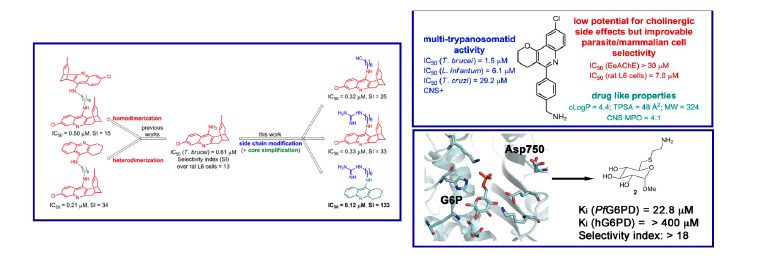
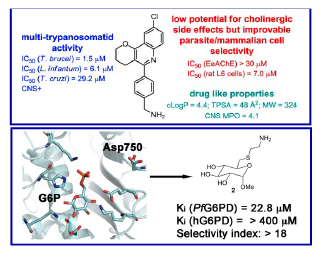
Figure 2. Up: Chemical structure of YAT2150, subcellular localization in red blood cells parasitized with P. falciparum (confocal fluorescence microscopy colocalization analysis in different P. falciparum blood stages of YAT2150 with the cytosolic marker ER TrackerTM Green), and fluorescence microscopy image of live macrophages exposed to CFSE-stained L. infantum (nuclei stained with Hoechst 33342 and protein aggregates with YAT2150, the arrow head indicates a Leishmania-containing phagolysosome) (images from BMC Biol. 2022, 20, 197 and Antimicrob. Agents Chemother. 2024, 68, e0112723). Down, left: Structure and antitrypanosomal activity of the lead huprine and some homodimers, heterodimers, and side chain modified derivatives (image from Bioorg. Med. Chem. 2016, 24, 5162-5171). Down, right: Multicomponent reaction-based synthesis of multi-trypanosomatid quinoline derivatives (Eur. J. Med. Chem. 2015, 105, 120-137) and antimalarial glucose-6-phosphate dehydrogenase inhibitors designed from the first homology model of Plasmodium falciparum G6PD (Eur. J. Med. Chem. 2018, 146, 108-122).