|
U n i v e r s i d a d d e B a r c e l o n a |
Departamento de Personalidad, Evaluación y Tratamientos Psicológicos |
Cursos asistidos por ordenador a través de i n t e r n
e t |
|
U n i v e r s i d a d d e B a r c e l o n a |
Departamento de Personalidad, Evaluación y Tratamientos Psicológicos |
Cursos asistidos por ordenador a través de i n t e r n
e t |
| Phrenology
Today, even the least informed high school student knows that many functions of the brain are carried out by particular structures, and not by others. For example, the external part of the brain, called cortex, has regions which are responsible for different functions, such as the perception of vision and hearing, the control of movement and speech, as well as the higher mental faculties (cognition, planning, reasoning, etc.). This doctrine, which has been proved over and over again in this era where sophisticated equipments, supported by computers, are able to visualize with pinpoint precision where a given function is being performed in the brain, is called cerebral localizationism. But this was not so in the final years of the eighteen century, the century of
Illumination. Knowledge about the brain was scanty and dominated by non-scientific
speculations. Objective experimentation with animals was still rare, and one the most
powerful methods of inferring brain function, the observation of persons with neurological
disabilities due to localized lesions of the brain, such as tumors, was still in its
beginning stages. The main source of knowledge about the brain were the dissections
performed on the dead bodies of animals and humans. Localization of function in the brain
could only be glimpsed from the fact that there are many different-looking anatomical
structures in it, so that, perhaps, they could be responsible for different faculties of
the mind. In this bleak scenario, enters the Austrian physician Franz Joseph Gall (1758-1828), who pioneered the notion that different mental functions are indeed located in different parts of the brain. This happened exactly 200 years ago, in 1796 ! As we will see, he was right on this notion, but totally wrong on the way it was achieved by the brain. As a result, he produced phrenology (from phrenos=mind, and logos=study) the first complete theory of cerebral localizationism This was surely a major feat. However, phrenology was later discarded and castigated by the scientific establishment as a crude form of quackery and pseudoscience. But his historical importance remains, so's the reason for the present article.
The Theory Behind PhrenologyGall, in his noted work, "The Anatomy and Physiology of the Nervous System in General, and of the Brain in Particular", put forward the principles on which he based his doctrine of phrenology,. Firstly, he believed that man's moral and intellectual faculties are innate and that their manifestation depends on the organization of the brain, which he considered to be the organ responsible for all the propensities, sentiments and faculties.
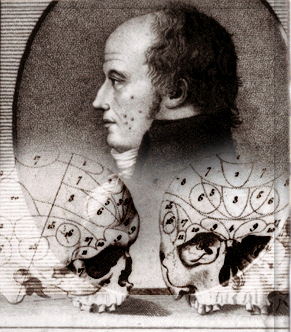
Finally, Gall proposed that the external form of the cranium reflects the internal form of the brain, and that the relative development of its organs caused changes of form in the skull, which could be used to diagnose the particular mental faculties of a given individual, by doing a proper analysis. In fact, Gall's theory was built the other way round. He carried out numerous and
careful observations and made many experimental measurements on the skulls of his
relatives, friends and pupils. Later on, with the help of his associates, he did that on
many persons with different personality characteristics. Gall thought that he was able to
correlate certain particular mental faculties to bumps and depressions on the surface of
the skull, its exterior forms or relative dimensions. Then, he mooted on the possibility
that these external landmarks could be caused by the growth of internal brain structures,
and that this growth was related to the development of the associated mental faculty.
Thus, he was able to produce a complete and extensive theory to support his work, and to
use it for practical applications in the mental sciences, by means of detailed topological
maps. The most important collaborator of Gall was Johann Spurzheim (1776-1832), who
later helped him to extend the so-called phrenological model and to disseminate it in
Europe and USA. Phrenology's DestinyThe logical and easy-to-learn structure of the phrenological theory quickly captured the imagination of thousands of followers. The preciseness and scientific assurance of its terms and maps made headway in a time where the main enemies of rationalism were religion, subjectivity and autocracy. Due to this, Gall gained the support, if not the minds, of many important scientific and political figures in many parts of the world. He was their champion, in a terrain dominated by the teachings of religious philosophers. Eventually, phrenology was attacked by the scientific establishment, which could not corroborate Gall's theory with concrete findings. Already in 1808, the Institute of France assembled a committee of savants. led by Cuvier, who declared that phrenology was not to be trusted (some historians suspect that they also had no scientific evidence to support this claim, and that the conclusion was forced by Napoleon Bonaparte, who was furious because Gall's interpretation of his skull "missed" some noble qualities he thought he had...) Phrenology was equated to other forms of quackery, mainly due to the abuses in the hands of shady commercial entrepreneurs. Its demise happened in the final quarter of the nineteen century. However, it spawned many other scientific or pseudoscientific branches based on the quantitative analysis of facial and cranial features, such as craniology, anthropometry and psychognomy, many of which survived well into modern eras. Amazingly enough, there are still followers and believers of phrenology around. |

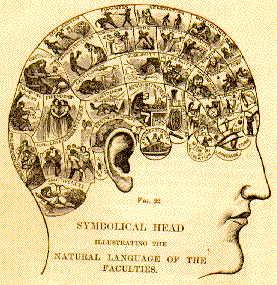 Secondly,
Gall proposed that the brain is composed of many particular "organs", each one
of them related or responsible for a given mental faculty. He proposed also that the
relative development of mental faculties in an individual would lead to a growth or larger
development in the sub-organs responsible for them.
Secondly,
Gall proposed that the brain is composed of many particular "organs", each one
of them related or responsible for a given mental faculty. He proposed also that the
relative development of mental faculties in an individual would lead to a growth or larger
development in the sub-organs responsible for them.