

News & Events

The impact of demographic change on public Long-Term Care costs
The WIFO team has published a new report examining the influence of demographic change, education and health on future care needs and public care costs. In Austria, a significant increase in care expenditure is evident, primarily driven by rising life expectancy, though the expansion of education has a dampening effect. Comparative analyses of Austria, Spain…
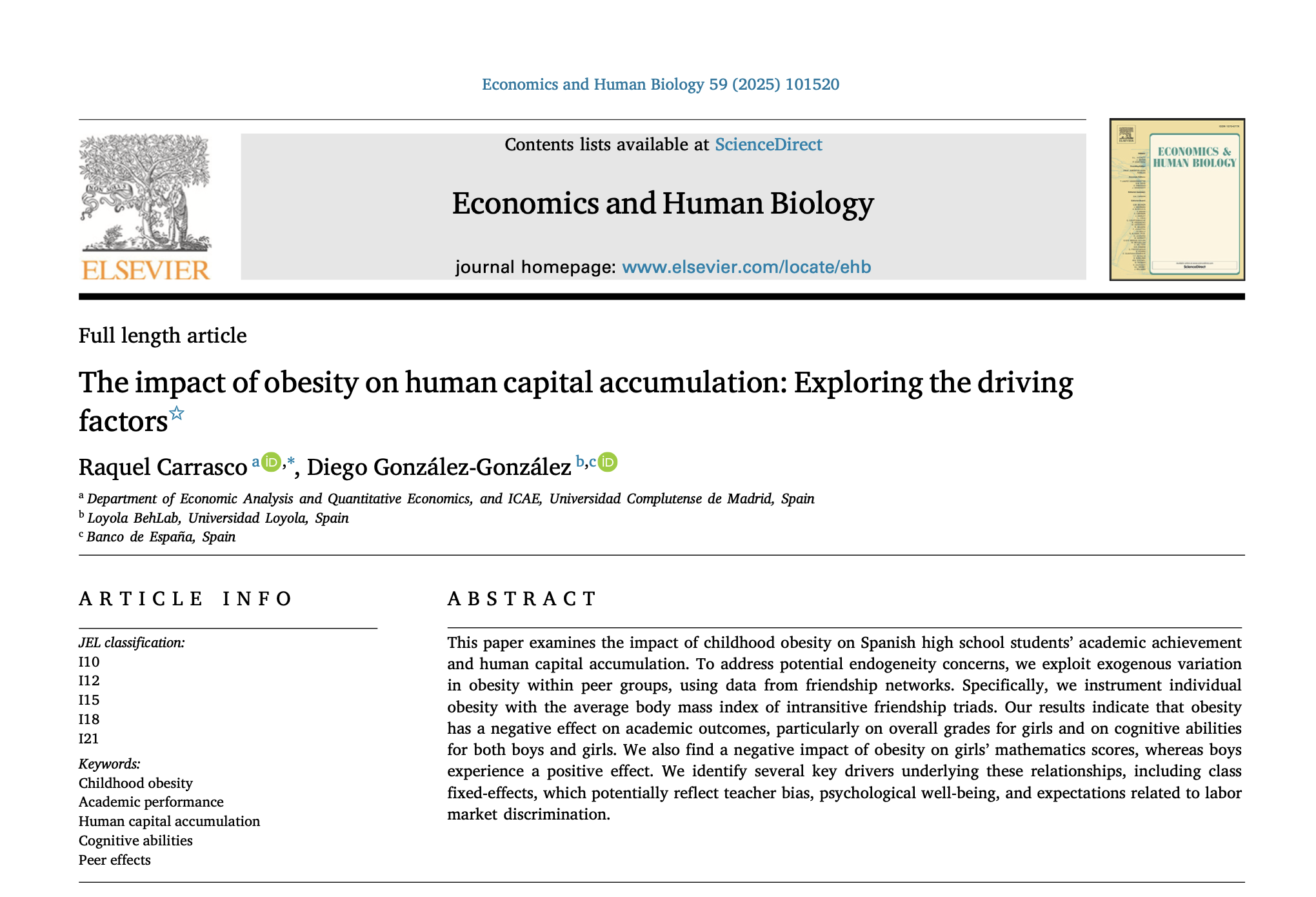
The impact of obesity on human capital accumulation: Exploring the driving factors
Abstract This paper examines the impact of childhood obesity on Spanish high school students’ academic achievement and human capital accumulation. To address potential endogeneity concerns, we exploit exogenous variation in obesity within peer groups, using data from friendship networks. Specifically, we instrument individual obesity with the average body mass index of intransitive friendship triads. Our…

NEW OPEN ACCESS PUBLICATION
Lifecycle analysis of the gender gap in paid and unpaid work by household structure Abstract The paper provides new insights into men and women’s lifetime contributions to the overall economy and societal well-being, taking both market and non-market activities into account. It extends the National Transfer Accounts (NTA) and National Time Transfer Accounts (NTTA) methodologies…

The Impact of Ageing, Socio-economic Differences and the Evolution of Morbidity on Future Health Expenditure – a Dynamic Microsimulation
Researchers from the WIFO team have released a new publication about the impact of population ageing on healthcare expenditure. They use dynamic microsimulation to project healthcare expenditure in Austria and disentangle the effects of changes in longevity, population age-structure, healthy life years and socio-economic health disparities. By combining price weights for healthcare services with information…

External Effects of the Pension System in the Context of the Welfare State
This paper provides results from different studies conducted by the Gemma Abio, Ció Patxot (UB) and Guadalupe Souto (UAB) and other authors aiming at measuring the external effects generated by the existence of an intergenerational transfer system, such as the pension system, and the welfare state as a whole. The primary reason for the presence…

Life course heterogeneity and the future labour force: A dynamic microsimulation analysis for Austria
Using Austria as a case study, this paper demonstrates how capturing life course heterogeneity improves the accuracy and policy relevance of socio-demographic projections, and how considering this population heterogeneity impacts labour force dynamics and economic dependency ratios. The authors introduce and apply the microsimulation model microDEMS, focusing on education, migration background, health and labour market…

Paying £1 or nothing in Dictator Games: Unexpected differences
The paper investigates the case of social preferences: do hypothetical rewards elicit different social behaviour than real but small monetary rewards in online experiments? To answer this more precisely, the Universidad Loyola Andalucia team have conducted an online Dictator Game experiment in which 1,195 participants decided how to split £1 with another participant (63% female, average…