
A new research project granted to Iria SanMiguel
26/04/2015
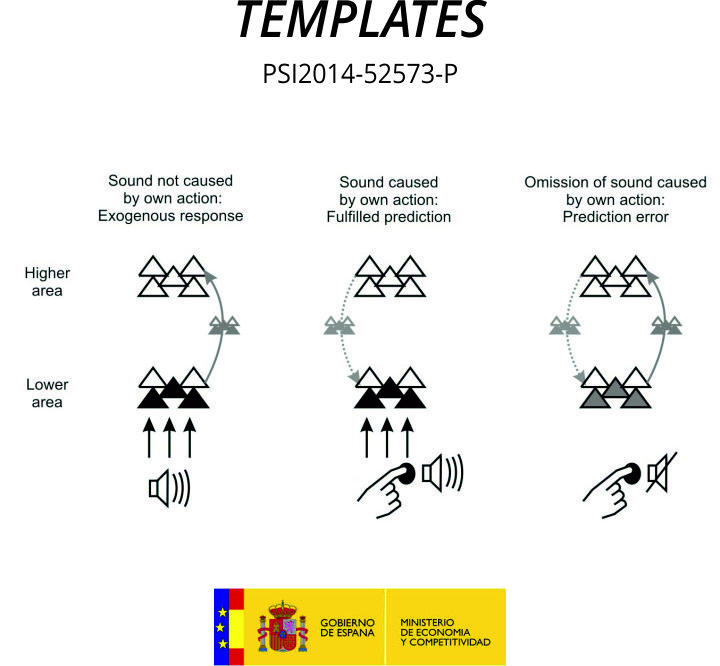
TEMPLATES: Exploring sensory templates for predictive processing through motor-sensory associations (PSI2014- 52573-P). This is the title of the research project granted to Iria San Miguel by the Spanish Ministry of Economy and Knowledge, through its program Proyectos de I+D “EXCELENCIA” . Funding was 64700€ for three years.
The summary of the project reads as follows:
How the brain extracts meaning from sensory signals is not fully understood. An influential view of brain function proposes that perception is an active process, in which prediction plays a fundamental role. According to predictive coding models, the brain constantly formulates predictions about the sensory input, which are contrasted against the sensory input, and in fact the brain signals that are transmitted up the sensory hierarchy represent only the prediction error. One consequence of this neural architecture is that responses to predictable stimulation are suppressed compared to the responses elicited by stimuli that are unpredictable. There is a substantial amount of empirical evidence showing that this is the case. However, this is only indirect evidence for the assumption that predictions are being formulated. Observing predictions in themselves has proven a difficult endeavour. For this reason, very little is known about how the forward model that formulates sensory predictions is implemented in the brain, and about the specific nature of the predictions that are presumably sent down the hierarchy. In this project we make use of a unique tool to uncover the neural representation of predictions. In previous studies, we have demonstrated that when participants self-administer the sensory stimulation via their motor acts, particularly robust predictions about the stimulation are generated. A simple trick that can be employed to uncover the representation of predictions is to unexpectedly omit the expected sensory consequences of the motor act. Using this strategy in previous studies, we have been able to isolate unique electrophysiological signals showing that the brain makes use of sensory templates to represent predictions. In this project, we aim to further validate a hypothetical neural architecture based on the principles of predictive coding, making use of these electrophysiological markers of prediction. In particular, the focus of the project will be on attaining a better understanding of the sensory templates which seem to underlie prediction, and their relationship to conscious perception. The experiments follow two main lines of questioning: 1) exploring the difference between positive and negative prediction errors, and how these differences relate to conscious perception, and 2) testing the assumption derived from the model that the suppression of brain signals to predictable sensory stimulation should be equivalent to the underlying prediction signals that can be uncovered with stimulus omissions.