On May 15th and 16th, our group participated in the XII Festa de la Ciència of the University of Barcelona, presenting our scientific outreach workshop: “The Chemical Journey of Food Inside the Body.” Through interactive activities, we demonstrated to students and the general public how structural biology, molecular interactions, and microbiota research advance our understanding of diseases and contribute to the development of novel therapeutic strategies. The event offered an excellent platform to communicate computational chemistry in an accessible manner and to encourage scientific interest in metabolism and food science among younger generations.

We extend our gratitude to all the visitors who engaged with our workshop and to the University of Barcelona for organizing this impactful event.

This successful initiative was driven by our dedicated team: Mireia Gómez Gordo, Paula Vidal, Katerina Barmpidi, and Carolina Estarellas led the activities on Friday, while Carlos Cruz Marin, Brian Medel Lacruz, Marcelo Andrés Guzmán Tudela, and Mireia Gómez Gordo concluded the workshop on Saturday. To celebrate the completion of the event, the team gathered afterward to enjoy a traditional paella together.

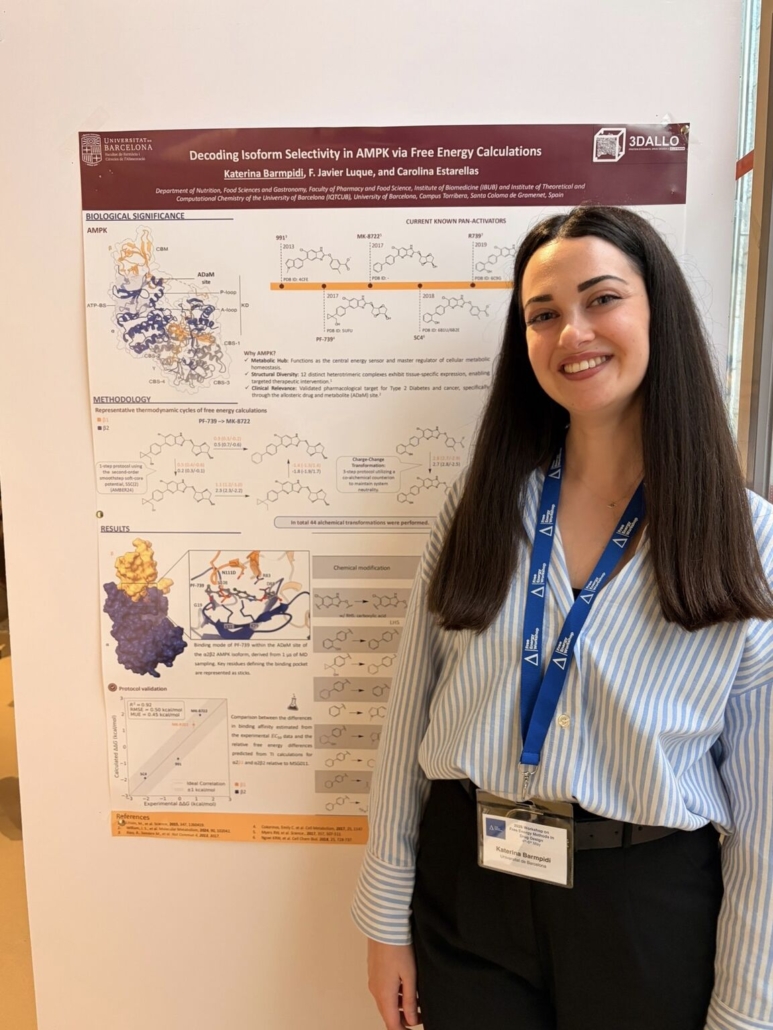
From May 4th to 6th, our group made a strong showing at the 2026 Workshop on Free Energy Methods in Drug Design, held right here in Barcelona!

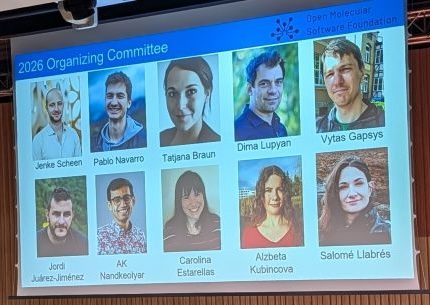
The event was a fantastic gathering of global experts in computational chemistry, focusing on the latest advancements in alchemical free energy simulations. It provided a perfect stage for our team to exchange insights and showcase our current research: our PI, Carol, contributed to the success of the event as part of the Organising Committee, while Katerina actively shared our team’s work, delivering both a poster and a flash presentation.

Beyond the intense scientific sessions, a major highlight was the lively Happy Hour sponsored by Schrödinger on the evening of May 5th, a perfect opportunity to network and connect with colleagues.

Thank you to everyone involved for making it such an inspiring and enjoyable workshop!

We are excited to share a new publication co-authored by Katerina and Carol: “Spiranic compounds as novel AMPK paradoxical inhibitors: can we derive new mechanistic insights?” in the European Journal of Medicinal Chemistry. The study presents the design, synthesis, biological evaluation, and computational characterization of a new family of spiranic compounds targeting AMP-activated protein kinase (AMPK).

Our findings reveal that these molecules exhibit a paradoxical inhibitory profile, combining direct inhibition of AMPK activity with activation of downstream signaling pathways. Through a combination of biochemical assays, structural modeling, and molecular simulations, we identified a previously unexplored binding region associated with the closed conformation of the AMPK activation loop.

The work provides new insights into AMPK regulation and highlights alternative mechanisms for modulating this therapeutically relevant target. These results open new perspectives for the development of chemical probes and future therapeutic strategies aimed at metabolic and cardiovascular diseases.

Congratulations to all collaborators involved in this multidisciplinary effort.

Scan the QR code or click here to read the full paper:

Last week, Katerina, Mireia and Carol participated in several outreach sessions at secondary schools in the Vallès area as part of the #cientifiques initiative.
During these visits, they shared their professional journeys with primary and secondary school students, presenting different pathways into scientific careers and highlighting the role of women in STEM fields. The sessions aimed to make research more visible and accessible, showing students that there are multiple routes into science and that curiosity and perseverance are key elements of any scientific path. They also took time to answer their questions and discuss what working in research involves on a day-to-day basis.

Preparing and organizing this activity in collaboration with the schools was also an opportunity for internal engagement. The entire research group contributed at different stages of the process, turning the initiative into a valuable team-building experience and reinforcing our collective commitment to outreach and education.
Engaging with students at such an early stage is both a privilege and a responsibility. We hope initiatives like this continue to grow and contribute to building stronger connections between research and the educational community!

Our group recently visited the Vinya d’en Sabater and the Escuela de Restauración de Santa Coloma, both located within the Campus de l’Alimentació de Torribera in Santa Coloma de Gramenet.

The Vinya d’en Sabater is an ecological and vegan vineyard that spans one hectare, cultivating five grape varieties, Pansa Blanca, Picapoll Blanc, Garrut, Garnatxa, and Picapoll Negre, and has been part of the DO Alella since 2020. Over the past decade, more than 13,000 kg of grapes have been harvested, involving over 200 participants through local training and employment programs. The vineyard has become a model of sustainability, education, and community engagement, and was recently honoured with the Premi Vinari for Best Recovery Initiative for its role in reviving Santa Coloma’s winemaking tradition.

After the vineyard tour, we were warmly hosted by the Escuela de Restauración de Santa Coloma, where we prepared huevos revueltos con rebozuelos, ajo y perejil and mousse de mató con miel y carquinyolis, featuring traditional Catalan products. The visit beautifully combined sustainability, gastronomy, and local heritage.

The 12th edition of the EFMC Young Medicinal Chemists’ Symposium (EFMC-YMCS) took place in Porto, Portugal, on September 4-5, 2025. Jointly organised by the European Federation for Medicinal Chemistry and Chemical Biology (EFMC) and the EFMC Young Scientists Network (YSN), the event was held in connection with the X EFMC International Symposium on Advances in Synthetic and Medicinal Chemistry (EFMC-ASMC 2025).

Katerina Barmpidi presented a poster showcasing her latest results on free energy calculations for a new generation of AMPK modulators. Her work contributes to the understanding and design of potent AMPK activators through advanced free energy perturbation (FEP) methods, highlighting recent progress in computational approaches for drug discovery.

On June 17th our group participated in the CBDD Group Meeting, an annual conference held within our wider group. This year’s topic was “Computational Applications to Structure-Function and Structure-Activity” and we were very grateful for the participation of the group of Prof. Antonios Kolocouris from the University of Athens, Greece

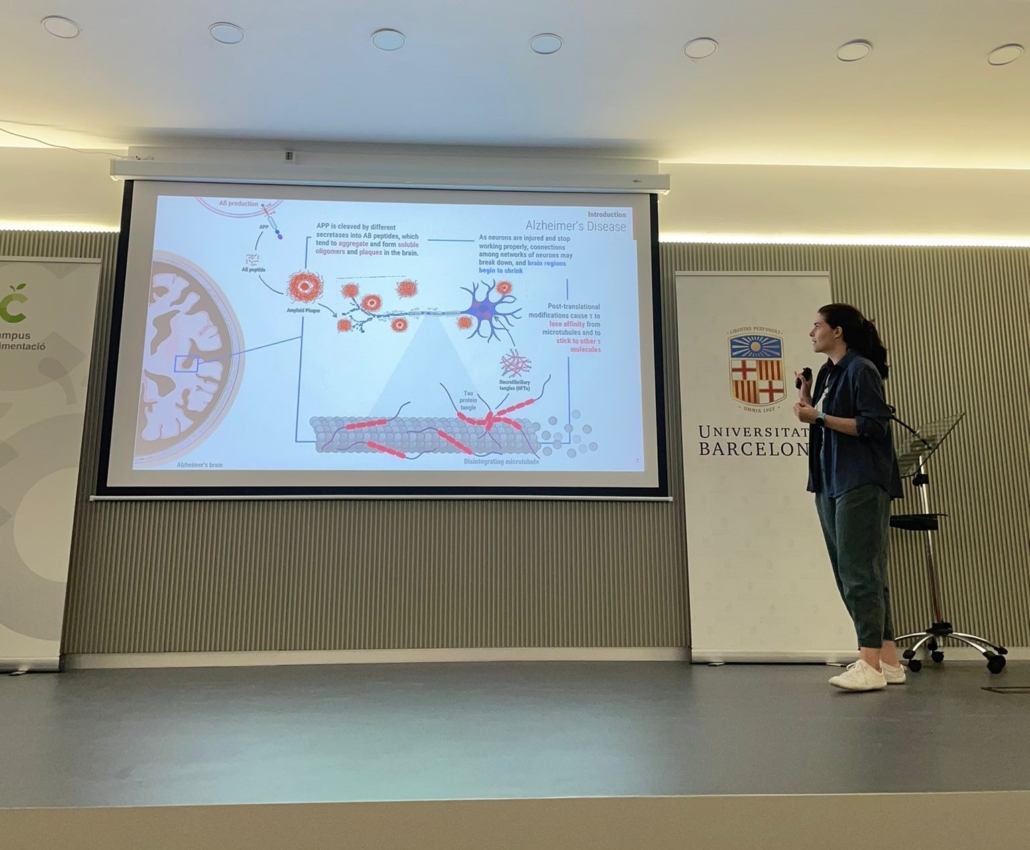
Several PhD students participated by giving short talks about their projects. Mireia presented the latest developments of the Alzheimer’s project entitled “Computational assessment of monomeric Aβ folding: Paving the way for the aggregation study,” while Carol showcased her research lines, fostering discussions and potential new collaborations.

On the last weekend of May, our group participated in the annual Festa de la Ciencia organised by the University of Barcelona, a full day science fair where research groups turn Plaça Universitat into a huge open-air laboratory. People from all ages came to our stand to learn about how proteins are dynamic, the different compounds found in every day foods, and a bit from our different projects. This year, we added a mini Build Your Own Molecule station, in which young (and not so young!) participants could become a chemist for a day and play with building blocks to form a compound. Moreover,we included a 3D model of one of our main targets: AMPK.

Come find us in the next edition!

Katerina Barmpidi participated in the 20th Hellenic Symposium on Medicinal Chemistry held in Ioannina, Greece, where she presented her work on AMPK modulation, part of her ongoing PhD project in computational drug discovery.

As a board member of the EFMC Young Scientists Network (EFMC-YSN) of the European Federation for Medicinal Chemistry and Chemical Biology (EFMC), Katerina was delighted to represent the network, meet enthusiastic young researchers, and exchange ideas on initiatives to further strengthen the scientific community.

Congratulations to Albert who has been awarded with the FPI predoctoral fellowship from the MdM program of IQTC to pursue his Ph.D. which will focus on the rational drug design of inhibitors of targets related to infectious diseases.

We hope you can enjoy learning and advancing in your career in our group!!!