
esign Group

rug

D

D

iology &

omputational

C

B

esign Group

rug

D

D

iology &

omputational

C

B

esign Group

rug

D

D

iology &

omputational

C

B

esign Group

rug

D

D

iology &

omputational

C

B

esign Group

rug

D

D

iology &

omputational

C

B

esign Group

rug

D

D

iology &

omputational

C

B

esign Group

rug

D

D

iology &

omputational

C

B

esign Group

rug

D

D

iology &

omputational

C

B

esign Group

rug

D

D

iology &

omputational

C

B

Welcome CBDD

WELCOME to Computational Biology and Drug Design (CBDD) group
The CBDD is a research group pertaining to the Faculty of Pharmacy and Food Sciences, and their members are ascribed to the research centers:

  • the Institute of Theoretical and Computational Chemistry (IQTCUB),
  • the Institute of Biomedicine (IBUB), and
  • the Institute for Nutrition and Food Safety Research (INSA).

Our research is focused on the study of the chemical properties of small (bio)organic molecules and their recognition and binding with macromolecular targets. Emphasis is made in understanding the molecular determinants of biomolecular association, the relationships between structure and biological function, and the design of novel bioactive compounds, especially regarding the application in drug discovery.
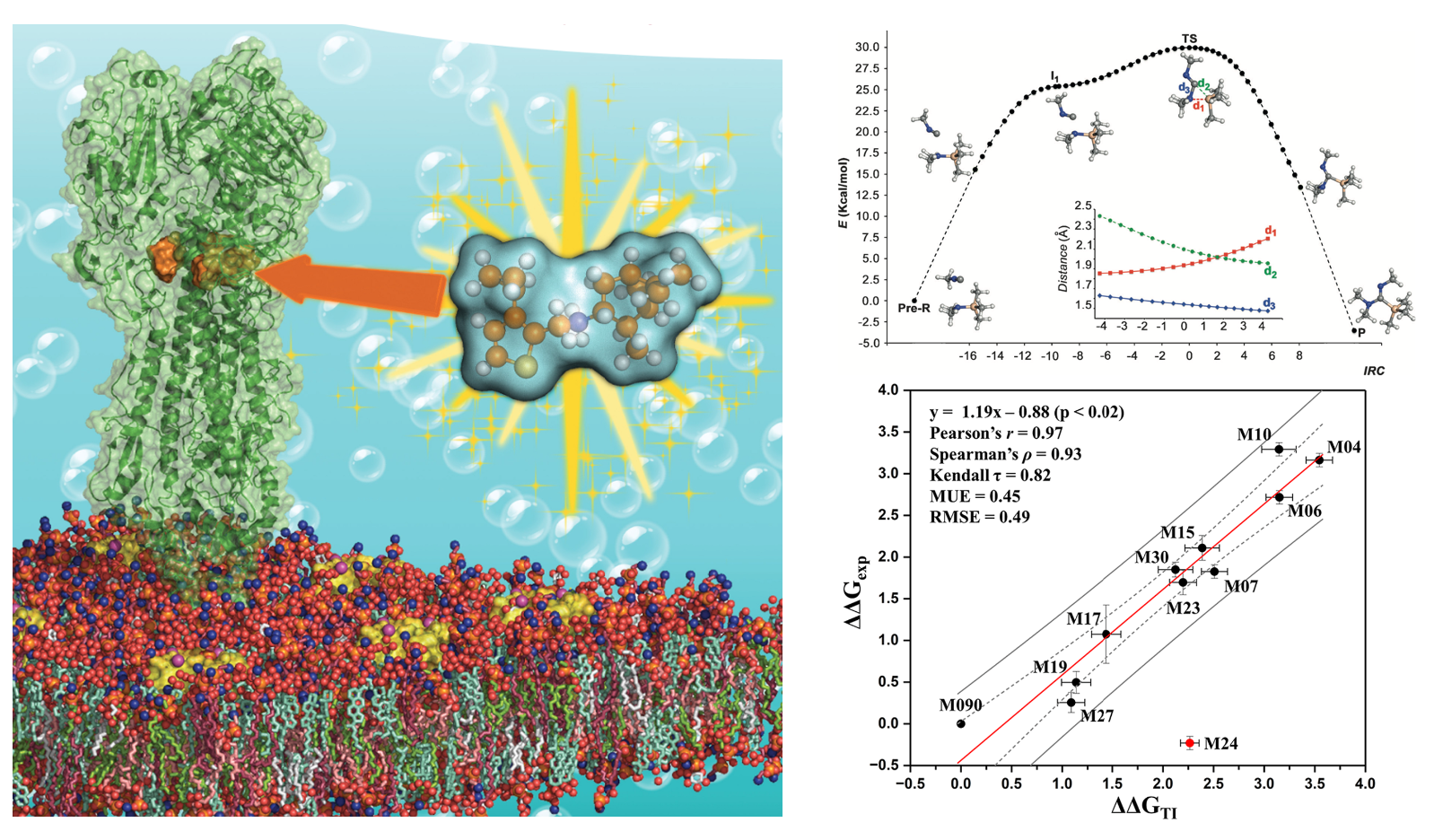
Our research is mainly performed by using a variety of tools afforded by theoretical and computational methods of molecular modeling, quantum chemistry, classical simulations, advanced sampling techniques, and computer-aided drug design. Nevertheless, we have consolidated over the years a crosstalk with experimental groups in chemical synthesis and biophysical studies.
Furthermore, our research also comprises the development of novel methodologies for the study of molecular recognition and drug design, which is mainly done in collaboration with Pharmacelera (https://pharmacelera.com/).

The major research areas are:

Computational Chemistry

Our interest here is to examine the chemical properties of molecules to understand their propensity to participate in reactive processes and to form noncovalent interactions. In this context, we are interested in the chemical reactivity of small compounds that can be used as reduced models of biomolecular systems, as well as to the influence exerted by the environment on the modulation of chemical reactivity. We are also interested in the mechanistic events that dictate the outcome of complex reactions.

Computational Biology

Our aim is to translate the knowledge about the properties of molecules to the interaction with macromolecular targets and the regulation of the biological response. This interest has been focused on the development of multitarget compounds targeting neurodegenerative diseases. Another area of interest has been the role of the truncated hemoglobin N from M. tuberculosis, which plays a key role in eliminating nitric oxide, thus contributing to the survival of the bacillus…

Computational Gastronomy

Computational gastronomy is an emerging discipline placed at the data analytics–gastronomy interface. Two projects are currently being developed within this field: CC-Cuina (Culinary Corpora Comparison) and Appetit. CC-Cuina analyzes ingredients, techniques and the relationship between them in culinary recipes applying information extraction, natural language processing and network analysis techniques. Classification of ingredients and techniques as…

CHEMICAL SYNTHESIS

Our expertise in organic synthesis pursues the design and synthesis of new bioactive molecules as potential therapeutics for the treatment of neurodegenerative and diet-related diseases. In addition, we are also interesting in exploring the linkages between gastronomy and health sciences, looking at the impact of dietary patterns, functional foods and the use of food waste on health and sustainibility.

BIOPHYSICAL STUDIES

Our goal is to design new therapeutic tools to target diseases associated to ‘undruggable’ targets, which cannot be approached using conventional drug discovery. To this end, we emply a multidisciplinary research  for developing  of novel compounds suitable for targeted protein degradation.

LET’S MOVE SCIENCE FORWARD TOGETHER

Allo3D group aims to develop novel therapeutic strategies working with novel and promising enzymes related to cardiovascular diseases, like CutC:CutD complex found in human gut microbiota, and metabolic diseases, mainly focused on obesity and diabetes, in which AMPK enzyme is our main target. This is achieved by application of state-of-the-art computational and theoretical techniques of quantum mechanics, molecular dynamics simulations and enhanced sampling methods.

We are located at the Torribera Food Science Campus of the Faculty of Pharmacy and Food Sciences of the University of Barcelona. We are members of the Computational Biology and Drug Design consolidated research group (2021 SGR 00671) and the Institute of Theoretical and Computational Chemistry (IQTC).

QUOTE-PENDING

Our lab is focused on understanding the dynamic-structure-activity relationships between small organic molecules and peptides with biomacromolecular targets mainly to be applied in Drug Design.

Our aims are to disclose the allosteric network communications, understand selective activation exerted by modulators towards specific isoforms, study of radical chemical reactions and self-aggregation processes in order to design novel therapeutic strategies or bioactive compounds. This is achieved by utilizing a wide array of computational techniques involving QM and QM/MM methods, classical molecular dynamics simulations or alchemical and enhanced sampling techniques. Additionally, we are developing new computational tools for improving pharmacokinetic profiles.

All these projects are carried out thanks to ours established collaborations with other academic research groups and technology-transfer contracts with industry.

Our latest news

The final meeting of the Computational Biology and Drug Design research group

The final meeting of the Computational Biology and Drug Design research group

Congratulations

Congratulations to Marina Corbella, Mariano Curti and Antonio Viayna for the success in gaining a Lecturer position at the Department of Pharmacy, Pharmaceutical Technology and Physical Chemistry.

Defense of the PhD thesis Computational

Congratulations to Aitor for the defense of the PhD thesis Computational exploration of protein-ligand interactions

Jaume I atorga potestat

Titus. Les armes seguint guerres així en mar com en terra.

Notum sit omnibus quod nos Iacobus, Dei gracia rex Aragonum, comes Barchinone et dominus Montispesulani, consilio consiliariorum nostrorum Aragonum et Cathalonie damus tibi, fideli nostro Petro de Monte Alteto, et universis pastoribus Cesarauguste plenam licenciam et potestatem iusticiandi omnes latrones et raubatores, qui cum malefacto et raubaria inventi fuerint in cabania aliqua Cesarauguste vel in aliquo loco eiusdem.
Ita quod nullus, de nostra gracia confidens, audeat vel presumat vos vel aliquem ex vobis ad capiendo raubatores vel latrones disturbare, agravare vel aliquod aliud impedimentum facere aliqua racione.
Datum Cesarauguste, XV kalendas iunii sub era M. CC. L. sexta.
Signum + Iacobi, Dei gracia regis Aragonum, comitis Barchinone et domini Montispesulani.

And of course there is more to explore.
Other noteworthy features are:

