
TWISTER
Prototype of TWISTocaloric cooling with Energy Recovery based on natural rubberThis is why the EU has imposed strict regulations [EU Regulation No. 517/2014], to phase out the use of fluorinated gases, which cause the greenhouse effect.
Hence, the problem of keeping our planet cool without increasing greenhouse gas emissions poses a stimulating challenge to scientists.

Nearly 70% of the world’s energy consumption is devoted to heating and cooling.

The dependence on fossil fuel sources is very high in heating technologies.

Cooling equipment uses gases with a high global warming potential (GWP).
Research into materials for elastocaloric (EC) cooling materials —which include metal alloys, polymers, etc.— shows that they can absorb and release heat when subjected to cyclic mechanical stresses.
EC materials have advantages over alternatives based on elastocaloric or magnetocaloric effects, as it is much easier to apply a mechanical stress than a large magnetic or electric field.
Natural rubber has been revealed as a potentially disruptive solid-state refrigerant. This material exhibits exceptional elastocaloric performance.
During the development of our previous Seed project (2021 LLAV 00080), it has been discovered that elastocaloric effects are significantly amplified under torsion instead of uniaxial tension, giving rise to the so-called twistocaloric effect.
The purpose of the TWISTER project is to develop the first prototype of twistocaloric refrigeration with natural rubber refrigerants.
This prototype is an improved version of our latest natural rubber-based elastocaloric device, which is currently operating in a laboratory environment.
Our new prototype incorporates coolant torsion and combines both uniaxial stretching and torsion to maximize cooling power and cool a closed water (or alternative liquid) circuit. In addition, it uses an energy recovery system.
We have applied for a European patent EP25382371 (April 9, 2025).
TWISTER is a clean solution based on rubber, a natural material that does not release gases into the atmosphere.

The use of rubber in TWISTER favors the circular economy, minimizing waste generation.

TWISTER increases cooling efficiency thanks to the energy recovery mechanism.
project and its application, please send an email to
functionalmaterials@ub.edu
Project team

Eduard Vives Santa-Eulalia
Coordinator
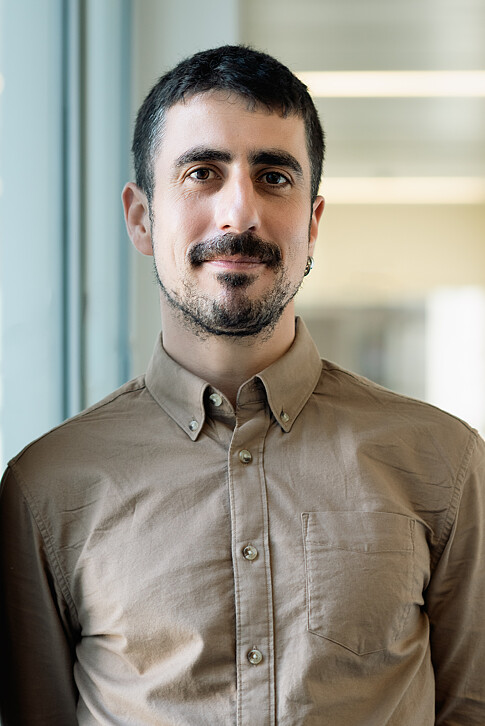
Enric Stern Taulats
Entrepreneurial Scientist

Emma Valdés Martín
Researcher

Toni Vives Cabaleiro
Engineer

Kübra Gürpinar
Researcher
Collaborations
Nicolas Candau (e-Plascom – UPC)
Featured Publications
Emma Valdés, Enric Stern-Taulats, Nicolas Candau, Lluïs Mañosa, Eduard Vives. Enhancement of the Elastocaloric Performance of Natural Rubber by Forced Air Convection.
Polymers 16, 3078 (2024)
https://www.mdpi.com/2073-4360/16/21/3078
Nicolas Candau, Adele Zimmy, Eduard Vives, Maria Lluïsa Maspoch Elastocaloric Waste/Natural Rubber Materials with Various Crosslink Densities
Polymers 15, 2566 (2023)
https://www.mdpi.com/2073-4360/15/11/2566


