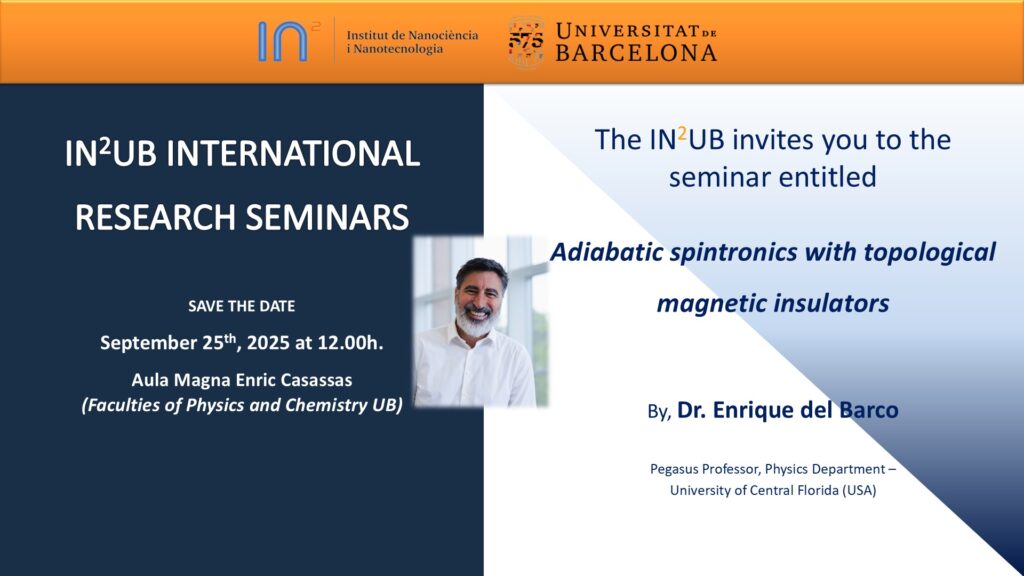
IN²UB INTERNATIONAL RESEARCH SEMINARS
Adiabatic spintronics with topological magnetic insulators
By, Dr. Enrique del Barco, Pegasus Professor, Physics Department – University of Central Florida (USA)
Date and Venue: Thu, September 25, 2025 at 12:00 – Aula Magna Enric Casassas (Faculties of Physics and Chemistry)
(Chaired by Dr. Antoni García-Santiago, IN²UB and Faculty of Physics)
Abstract
I will present our recent experimental demonstration of electrically induced antiferromagnetic resonance in the topological antiferromagnetic insulator MnPS₃, providing the first direct validation of a revolutionary theoretical framework in spintronics [1,2]. This theory, rooted in the concept of adiabatic spintronics, proposes that the dynamics of magnetic order in certain topological materials can be driven by a pure voltage—completely bypassing the need for electrical currents and, with them, the ubiquitous problem of Joule heating. Such a mechanism has profound implications for the future of information technology, particularly as data manipulation is projected to become the dominant source of global energy consumption. Our results confirm that the Neel spin-orbit torques can be generated electrically within a single insulating magnetic structure, eliminating the need for external spin sources or engineered heterostructures. The experiments were performed at frequencies in the 100 GHz range using a home-made, quasi-optical sub-THz microwave spectrometer. By continuously varying the polarization of the microwave excitation from linear to circular in both the Faraday and Voigh geometries, we were able to controllably switch the driving mechanism of the resonance from magnetic (Zeeman-type) to purely electrical (via the Neel spin-orbit torque). This polarization-tuning approach allowed us to isolate and unambiguously identify the electrically induced component of the resonance—offering direct evidence of adiabatic pumping effects predicted by the theory. This work, supported by the W. M. Keck Foundation, not only confirms the existence of a dissipation less voltage-driven control of magnetism, but also establishes topological magnetic insulators as a promising material platform for next-generation lossless spintronic devices. The implications extend to a wide range of technologies, including AI computation, where power efficiency is rapidly becoming the central challenge. I will conclude by discussing how these results open new directions for materials research, device engineering, and large-scale funding opportunities aimed at solving the energy crisis in modern computing.
References
[1] J. Tang and R. Cheng, Lossless spin-orbit torque in antiferromagnetic topological insulator MnBi2Te4, Phys. Rev. Lett. 132, 136701 (2024). [2] J. Tang, H. Zhang, and R., Néel Spin-Orbit Torque in Antiferromagnetic Quantum Spin and Anomalous Hall Insulatorshttps://arxiv.org/abs/2410.21751 (2025)
About the author
Enrique del Barco is Pegasus Professor of Physics at the University of Central Florida. He received a PhD from the University of Barcelona (Spain) in 2001, after which he completed a postdoctoral stay in the physics department at New York University, before joining UCF in 2005. His research interests are focused on the study of how the microscopic laws of physics –quantum mechanics– manifest themselves at a macroscopic scale. Quantum control of the magnetization and/or charge state in molecules and nanostructures will greatly impact molecular electronics, nanoscale spintronics and quantum information and computation technologies. In particular, del Barco studies i) the quantum dynamics of spin in single-molecule magnets: ii) electronic transport in single-molecule tunnel junctions: and iii) terahertz spin dynamics in antiferromagnetic spintronics devices. Del Barco has been recognized as Fellow of the American Physical Society.