OLID LAB
Tracing isotopes to track climate
and human impact

Welcome
to Olid Lab!

This is the lab website of Carolina Olid, Lecturer at University of Barcelona. We work at the intersection of environmental geochemistry and ecology, using radioactive isotopes and tracers to follow the movement of elements through landscapes, from soils and peatlands to rivers and lakes.

Our research focuses on how climate change and human activities modify the natural cycling of carbon, nutrients, and metals across terrestrial and freshwater systems. We are particularly interested in high-latitude and permafrost regions, where warming and environmental disturbance are rapidly transforming how elements are stored and released.

In our group, we combine fieldwork, lab analyses, and isotope tracing techniques to understand how environmental processes connect the land and water, and how these connections shape ecosystem function in a changing world.

We are based at the Faculty of Earth Sciences, where we collaborate with scientists from diverse disciplines to tackle environmental questions from multiple angles. Check out our research, get in touch, or come visit us. We’re always keen to discuss ideas about how landscapes record and respond to environmental change.

Research
fields

Radiotracers and geochronology

Using both natural and artificial radionuclides to date sedimentary deposits such as lake and marine sediments, and peat cores to reconstruct the timing of environmental changes.

Research
Network

Projects

Paisaje

Current Projects

Impact of permafrost groundwater flow on CH4 emissions from thaw ponds (PERMAFLOW)

The Arctic is warming nearly four times faster than the global average, triggering widespread permafrost thaw and profound changes in northern ecosystems. This thaw leads to the formation of numerous lakes and ponds, which act as significant sources of CH₄ emissions.

Some of the
latest projects

Pyrenean peatlands and carbon cycling: The role of overgrazing and climate change (PYREPEAT)

Carbon cycling

Thawing Effects on Soil Organic Carbon in Permafrost Peatlands: TESOCPE

Carbon cyclingPermafrost thaw

Cross-ecosystem Hg transfer in a thawing Arctic: linking permafrost, lakes and reciprocal food webs

Permafrost thaw

Meet the team
behind the research

Publications

Carbon cycling
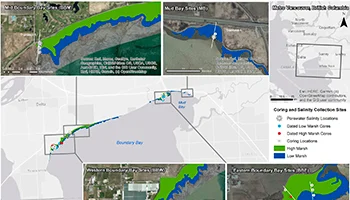
Spatial and temporal variability in blue carbon accumulation in the largest marsh in British Columbia, Canada.
Carbon cycling
Changes in lake sediment carbon accumulation rates in southwestern Canada since the mid-1800s.
Carbon cycling
Carbon accumulation in recently deposited peat is reduced by increased nutrient supply

Contact