
New global database reveals trends in oligotrophication in aquatic ecosystems
Photo:e.pastó
Reverse eutrophication, also known as oligotrophication, has been widely documented worldwide over the past 30 years in rivers, lakes, and estuaries. However, the lack of a complete and harmonized dataset prevents a deeper understanding of its ecological consequences.
To address this lack of data, Dr. Camille Minaudo, a postdoctoral researcher at the Biodiversity Research Institute (IRBio) of the University of Barcelona, has co-directed this project with Dr. Xavier Benito, from the Department of Evolutionary Biology, Ecology and Environmental Sciences of the UB, and has had the collaboration of an international team of scientists. The work resulted in the publication of the article “OLIGOTREND, a global database of multi-decadal chlorophyll a and water quality time series for rivers, lakes, and estuaries” in the journal Earth System Science Data.
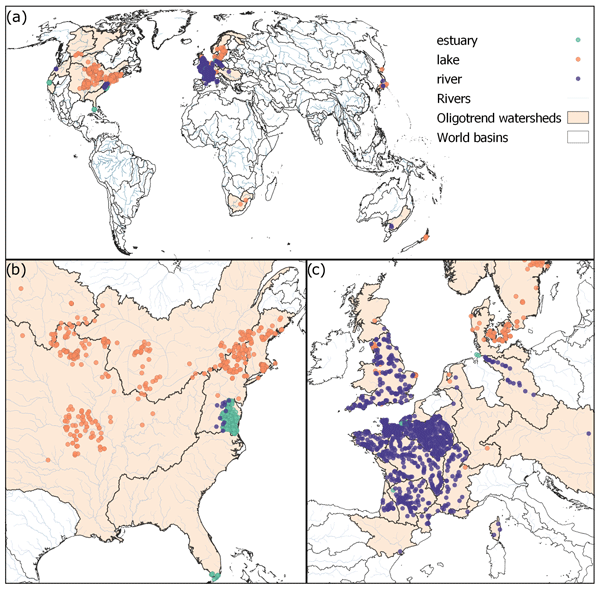
This work presents OLIGOTREND, a global database that collects more than 4.3 million observations of chlorophyll a, nutrients (nitrogen and phosphorus) and physicochemical parameters in 1894 sampling stations distributed in rivers, lakes and estuaries around the world. The database covers time series of more than 15 years, and allows analyzing trends in oligotrophication, a process of nutrient reduction that can reverse eutrophication and profoundly transform aquatic ecosystems.
The first analyses of the database show that 63% of the chlorophyll a series show a decrease in the second half of the analyzed period, indicating a general trend towards oligotrophication. This trend is even more marked for nutrients: between 78% and 87% of the nitrogen and phosphorus series show a significant reduction.
However, the ecological response is not uniform: only 18% of the chlorophyll a series show a clear decreasing trend, suggesting that other factors (such as light, temperature or ecosystem morphology) also influence primary production.
Global coverage and conclusions
In addition, the database also covers geospatial data, including attributes of watersheds and water bodies, climate variables and a robust trend analysis of all water quality time series.
The map shows the distribution of sampling stations included in OLIGOTREND. The database covers 33 large river basins and a wide variety of climatic and environmental contexts, from boreal to Mediterranean and tropical regions.
The article highlights the complexity of ecological responses to improved water quality, showing that nutrient depletion does not always lead to a proportional reduction in the biomass of primary producers such as phytoplankton.
A tool for open science and global change
OLIGOTREND represents a key tool for interdisciplinary research in aquatic ecology, biogeochemistry and global environmental change. Its open and harmonized structure will allow for future updates and integrations with other databases, numerical models and remote observations.
The article is available in open access through the following link: