
07-11-2025
The presence of reeds on riverbanks could be beneficial for fish
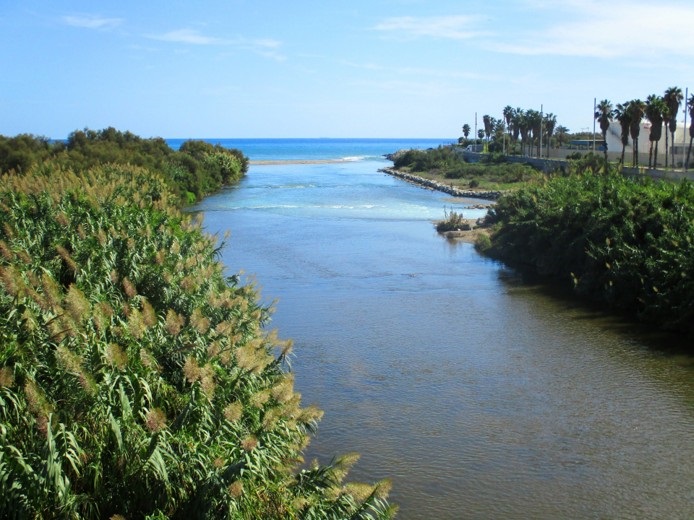
The presence of reeds, an exotic and invasive plant capable of altering the ecological balance in the natural environment, could have positive effects on fish populations in rivers. This is according to a study published in the journal Science of The Total Environment and led by Professor Alberto Maceda, member of the Research Group FORESTREAM from the Faculty of Biology and the Biodiversity Research Institute (IRBio) at the University of Barcelona.
Without underestimating the environmental impact of this grass on the natural environment, the study reveals the potential benefits that reeds can bring to river ecosystems under certain conditions. The study was also signed by experts from the UB’s Water Research Institute (IdRA), the Austral University of Chile, the University of Melbourne and the Arthur Rylah Institute for Environmental Research (Australia).
One of the world’s hundred most harmful invasive species
The giant reed (Arundo donax), native to Asia and some Mediterranean areas, is listed among the world’s hundred most harmful invasive species. It is one of the largest grasses known and is normally found in wetlands and lowlands, with shallow, slow-moving waters. When it forms extensive reed beds, it can alter the composition of the native vegetation and the surrounding natural environment.
“However, we should not assume that reeds are always harmful to fish conservation,” says Professor Alberto Maceda, from the UB’s Department of Evolutionary Biology, Ecology and Environmental Sciences.
To reach their conclusions, the team analysed more than 300 sampling points in 14 streams in north-eastern Spain, in a study area where reeds are particularly abundant. In these natural habitats, native species such as the redtail barb (Barbus haasi) and the Mediterranean barbel (Barbus meridionalis) are commonly found, but also invasive alien species, including the common carp (Cyprinus carpio) and the bleak (Alburnus alburnus). To assess the potential impacts of A. donax, the team analysed different indicators (body condition, functional diversity, taxonomic richness and relative abundance) in twelve species of river fish.
“The study reveals that there are parts of rivers, generally the lower and middle reaches, where reeds are almost the only relatively tall plants present, providing shade and a valuable habitat for fish,” Maceda points out. “Thus, the plant can offer shelter for fish in these Mediterranean lowland and midland rivers, where tall riparian plants are typically scarce.”
“The study also identifies correlational evidence of positive effects of the presence of giant reed on native fish abundance and body condition”, he continues. “However, negative effects on the overall functional diversity of fish communities have also been observed, probably because it creates a habitat that is too homogeneous.”
The study also reveals significant interactions between A. donax and local river conditions, suggesting that the plant’s impact on fish may vary in some circumstances.
“Without downplaying the serious threats posed by biological invasions, this study shows that, at least under specific environmental conditions, local removal of giant reed alone may not achieve the desired ecological outcomes if pre-existing relationships between fish and habitat are not taken into account,” concludes the researcher.
Reference article:
Maceda-Veiga, Alberto et al. “Effects of the invasive riparian plant Arundo donax on riverine fish: a call for action?”. Science of The Total Environment, July 2025. DOI: 10.1016/j.scitotenv.2025.180139:
Source: PressUB
Without underestimating the environmental impact of this grass on the natural environment, the study reveals the potential benefits that reeds can bring to river ecosystems under certain conditions. The study was also signed by experts from the UB’s Water Research Institute (IdRA), the Austral University of Chile, the University of Melbourne and the Arthur Rylah Institute for Environmental Research (Australia).
One of the world’s hundred most harmful invasive species
The giant reed (Arundo donax), native to Asia and some Mediterranean areas, is listed among the world’s hundred most harmful invasive species. It is one of the largest grasses known and is normally found in wetlands and lowlands, with shallow, slow-moving waters. When it forms extensive reed beds, it can alter the composition of the native vegetation and the surrounding natural environment.
“However, we should not assume that reeds are always harmful to fish conservation,” says Professor Alberto Maceda, from the UB’s Department of Evolutionary Biology, Ecology and Environmental Sciences.
To reach their conclusions, the team analysed more than 300 sampling points in 14 streams in north-eastern Spain, in a study area where reeds are particularly abundant. In these natural habitats, native species such as the redtail barb (Barbus haasi) and the Mediterranean barbel (Barbus meridionalis) are commonly found, but also invasive alien species, including the common carp (Cyprinus carpio) and the bleak (Alburnus alburnus). To assess the potential impacts of A. donax, the team analysed different indicators (body condition, functional diversity, taxonomic richness and relative abundance) in twelve species of river fish.
“The study reveals that there are parts of rivers, generally the lower and middle reaches, where reeds are almost the only relatively tall plants present, providing shade and a valuable habitat for fish,” Maceda points out. “Thus, the plant can offer shelter for fish in these Mediterranean lowland and midland rivers, where tall riparian plants are typically scarce.”
“The study also identifies correlational evidence of positive effects of the presence of giant reed on native fish abundance and body condition”, he continues. “However, negative effects on the overall functional diversity of fish communities have also been observed, probably because it creates a habitat that is too homogeneous.”
The study also reveals significant interactions between A. donax and local river conditions, suggesting that the plant’s impact on fish may vary in some circumstances.
“Without downplaying the serious threats posed by biological invasions, this study shows that, at least under specific environmental conditions, local removal of giant reed alone may not achieve the desired ecological outcomes if pre-existing relationships between fish and habitat are not taken into account,” concludes the researcher.
Reference article:
Maceda-Veiga, Alberto et al. “Effects of the invasive riparian plant Arundo donax on riverine fish: a call for action?”. Science of The Total Environment, July 2025. DOI: 10.1016/j.scitotenv.2025.180139:
Source: PressUB