RACAMed

Baetican production

RACA-Med: Organic Residues Analyses

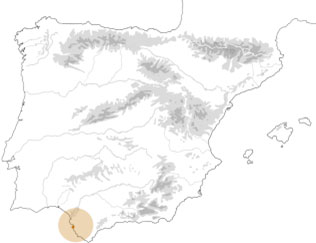
Location of Cadiz and the site of El Olivillo in Cadiz

        Ovoid amphorae

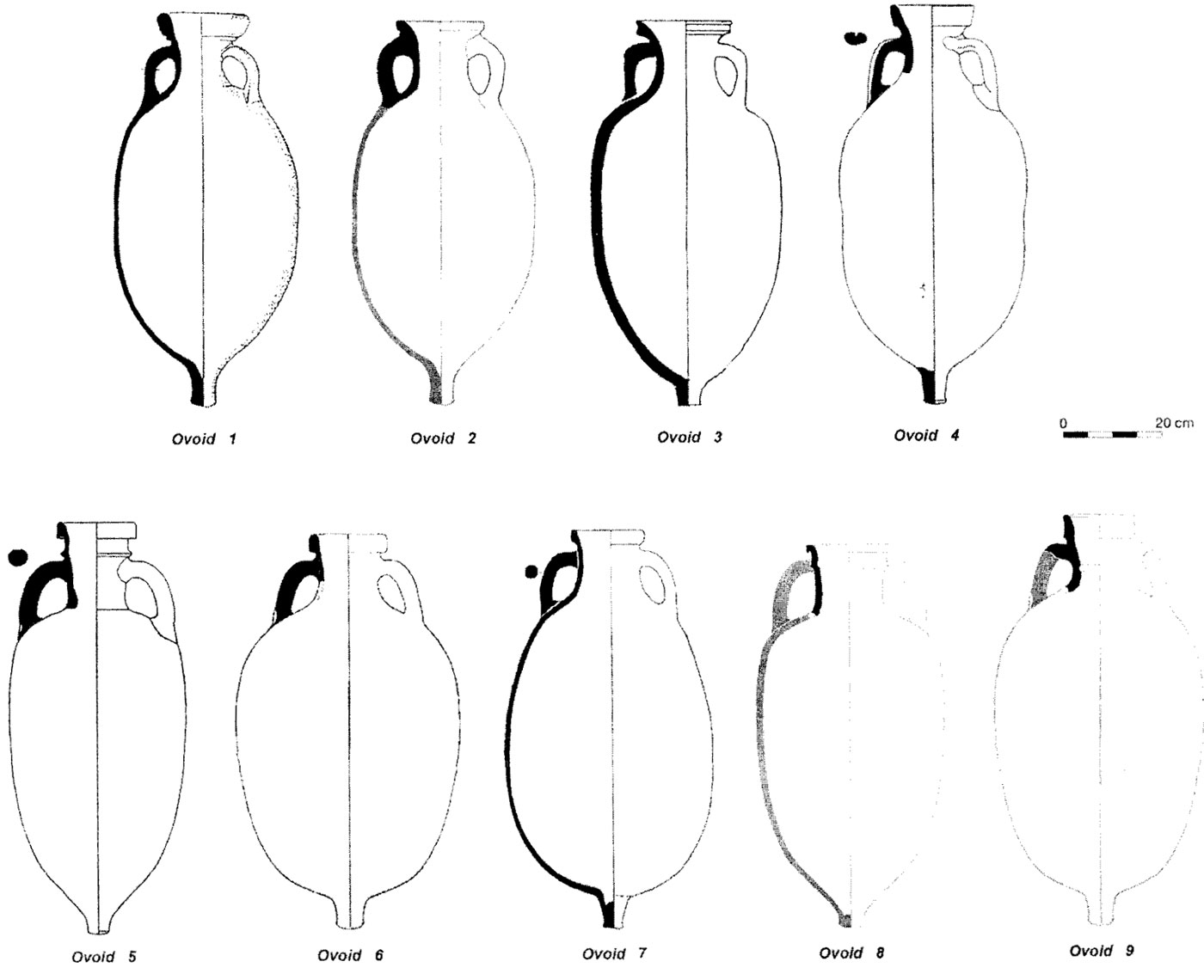
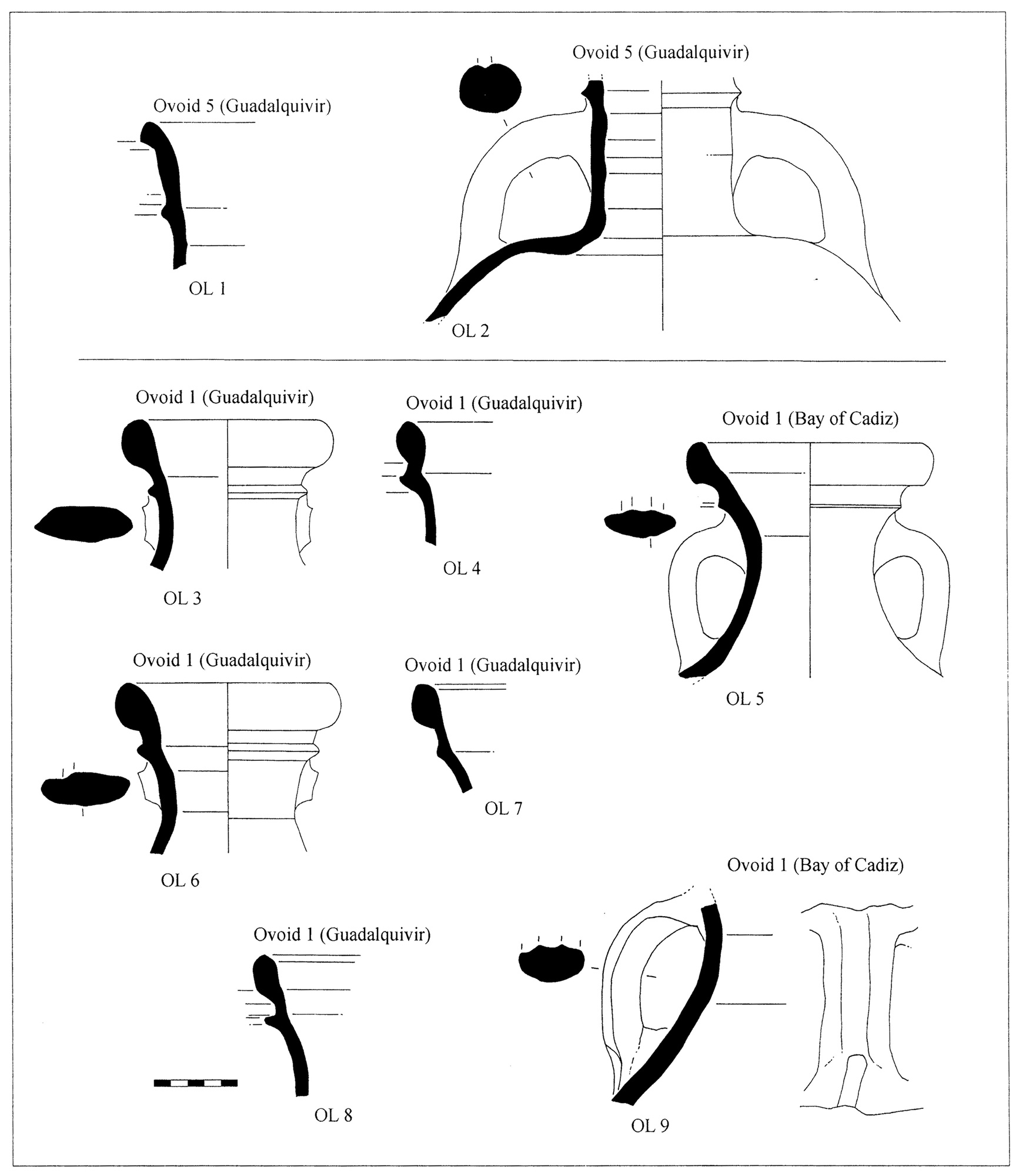
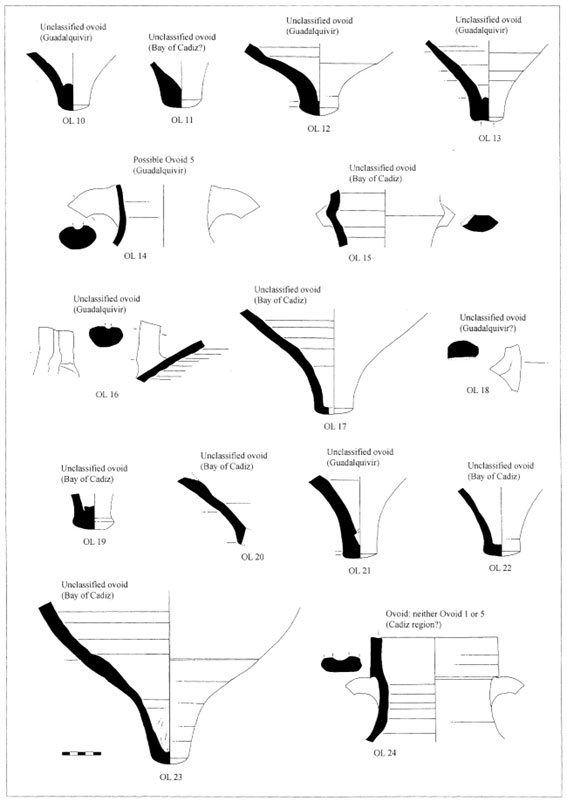
The rubbish dump excavated at El Olivillo (Cadiz) excavatet by the UCA (dir. D. Bernal), with finds ranging from the later 1st century BC to mid-1st century AD, provided the opportunity to sample 24 ovoid amphorae, from the Bay of Cadiz and from the Guadalquivir Valley. These were concentrated in the lower levels of the dump. Whereas some could be identified as either Ovoid Type 1 (seven examples) or Type 5 (two, possibly three examples), the majority were indeterminate (Table 1; Figure). Baetican amphorae with an ovoid body represent the first stages in the production of forms for the transport of agricultural surpluses in the late Republican province (for their complex typology, see Berni Millet 1998; de Almeida 2008; García Vargas, Almeida, González Cesteros 2011; García Vargas, González Cesteros, de Almeida 2019).


With very few contents analyses so far, there has been much debate as to their contents, with olive oil (especially those produced in the Guadalquivir Valley, as precursors to the Oberaden 83/Ovoid 7, later Haltern 71 and Dressel 20 oil amphorae) and fish products (for coastal workshops; García Vargas and Sáez Romero 2019) and, to a lesser degree, wine or derivatives such as defrutum, being the contents generally assumed to have been transported in them. Typologically, Ovoid 1 (70 BC-AD 20/30) and Type 5 (c. 60-15 BC) are typologically closely related to the ovoid amphorae of the north Peloponnese of the later 2nd century BC to Augustan period from Aigion and Corinth (Dr 25 and similis, with a flanged neck: Figure, for a likely early example from the Skyra Wreck), and to those of the Brindisian Apani-Giancola workshops, whose contents have not been scientifically determined, though olive oil is the primary content proposed for them (Figure: Filis 2019; Manacorda 2019: Giancola 2/Apani 1 is the only type suggested for wine, presumably as this is a variant of the Dr 6A); Reynolds 2021, 329, fig. 21). Previous analyses of two examples of Baetican ovoid amphorae, however, identified wine residues (or derivatives) in an Ovoid 1 and an Ovoid 5 (Bernal-Casasola, Pecci and Sáez 2019).   


The analyses of the El Olivillo samples by gas chromatography coupled with mass spectrometry have now provided evidence that 19 were pitched with pine resin and that a good number (18) carried wine (or grape derivatives). Of these 18 amphorae, seven displayed additional compounds: these included samples OL 1 and OL 2, with possible plant oils; and OL 3, with possible animal residues or the contents were mixed or the amphora re-used.


Six samples did not present tartaric acid. Though the majority bore pitch, note that no pitch was present for three amphorae containing wine or derivatives (OL2, OL14 and OL24) and OL20 was pitched but possibly contained a plant oil.


It remains to be seen if the sampling of Brindisian and Peloponnesian ovoid amphorae leads to the same results.

El Olivillo (Cadiz). Amphora samples OL 1 to OL 9.
El Olivillo (Cadiz). Amphora samples OL 10 to OL 24
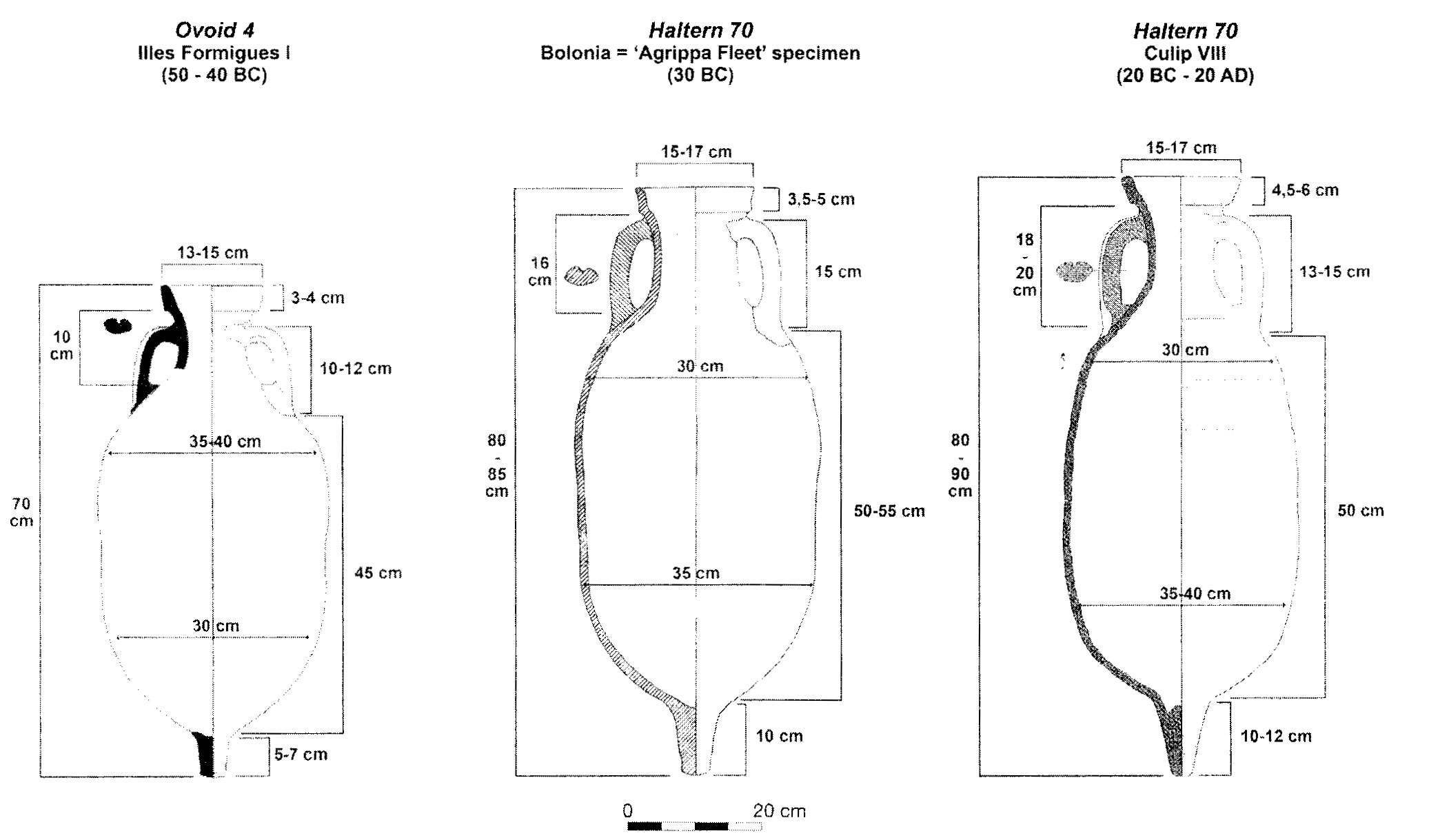
Fig 11 Evolution of Ovoid 4 to Haltern 70 (Garcia Vargas-Gonzalez Cesteros-De Almeida fig10)
Fig 12 Haltern 70 (P. Tyers, Potsherd Atlas)
Fig 14 H 70 'Olivae nigrae ex defruto penuariae' (Djaoui 2016, fig. 3)

Haltern 70

Haltern 70, with its ‘initial’ shape deriving from Ovoid Type 4, c. 30-20 BC (Figure), and ‘classic’ Augustan-Tiberian form emerging c. 20-15 BC (e.g. on the Culip VIII wreck), ended its production c. AD 90 (Berni 2011; García Vargas, E., de Almeida, R.R., González Cesteros, H. 2011, 242-248; García Vargas, González Cesteros, de Almeida 2019, 74-79; Carreras Monfort 2016; Carreras Monfort and Berni 2016). The type was produced primarily in Baetica, first on the coast – Cadiz-Algeciras, in workshops producing both wine and fish amphorae  – and then along the Guadalquivir, with imitations appearing also in Lusitania.


Djaoui (2016) recently reviewed all the known dipintos found on Baetican examples of this type – a mere 26 examples. Those on eight amphorae indicate that the form carried olives, primarily black but also green (albae/white) of various types (e.g. poseae, dulces) preserved in defrutum (e.g. OLIVA(E) NIG(RAE)/ EX DEFR(VTO)/PENVAR(IAE)/EXCELL(ENTES)/C. RVTILI[…]ICIS and OL[IVAE]/ A[LBAE]/ DVLCI). Olivae penuariae are ‘stored’, hence ‘preserved’ in defrutum. Six dipintos refer to the carrying of defrutum alone (e.g. DEF/EXC/ C ANTONI RVSTICI). Dipintos referring to fish sauce on eleven Haltern 70 amphorae were the result of secondary use. 


Note that a version of Haltern 70 was produced in Lyon (Lyonnais Type 7A), which was succeeded by Lyonnais 7B/Augst 21, from the late 1st or first quarter of the 2nd century. These contained olives, with 5 or 8 dipintos on Augst 21 (found in Vienne, Gallia Belgica, Germania and Britannia) referring to ‘white olives in sweet wine’ but not ‘black olives in defrutum’, which has led Djaoui to suggest that Spanish olives were transferred to these Gallic amphorae in Lyon, from barrels, following the end of production of Haltern 70.


Defrutum is must, boiled down from wine to a thick black alcoholic liquid (Flower and Rosenbaum 1958, 23-24: Palladius states that wine boiled down less than that, to two-thirds of its volume, was called caroenum, with sapa being that reduced to one-third). Defrutum served to enrich wines that were poor in glucose as well as a sweetener and liquid for conserves (e.g. Apicius I.XII.3, defritum (sic) added with honey to a jar (vas) of quinces; I.XII.6, sapa added to blackberries in a glass vessel (in vitreo vase)) and was an ingredient in medicinal remedies (Djaoui 2016, note 14).  Though the recipes of Apicius abound with references to the addition of liquamen, pounded with herbs in mortaria, sometimes mixed with wine, only a few refer to the similar use of certain types of defrutum: II.II.8,  defrutum of quinces or of dried figs, for a thick sauce added to meat rissoles. There are also references to the addition of caroenum or sapa, mulsum (wine mixed with honey), passum (sweet wine made from sun-dried grapes, well-attested from dipintos on early Imperial Cretan amphorae as well as the ‘pinched handle’ amphorae of western-‘Rough’ Cilicia, the Agora G 199 type). Apicius also refers to (unfermented) must as mustum (e.g. I.III.2: lemon leaves added to a jar in dolium musti, for 40 days, to which one could add honey when serving).


Cato tells his readers how to preserve lentils, green olives in vinegar (in acetum) or in must (mustum) and vinegar in a jar (in orculam) (De Agricultura, 117-118). There are also frequent references to vinegar in Apicius, for example I.VII.1: mustard prepared with vinegar (also referred to by Columella, De Re Rustica, XII.57); I.IX.1-2: for preserving fish or oysters, in a pitched vessel-vasculum picitum; I.XII.8-9: with honey, for preserving turnips; I.XII.11: for preserving peaches in a jar (in vas); as an ingredient with spices and liquamen for sauces: I.XV.1-2 (oyster sauce); (I.XVI.1-2: silphium sauce). The importance of the trade of vinegar also needs to be taken into account. A letter on a wax tablet (part of the Sulpicii archive) found in a villa outside Pompeii, from a Theophilus to his brother Aphrodisius, refers to the imminent arrival (probably in Puteoli) of the Octa, a ship carrying for him a cargo of ‘six medium-sized amphorae of wine, and seventy-seven of vinegar; sixteen Sicilian jars of honey, and ten of m(…..), one amphora of grape syrup [i.e. mustum or defrutum], one of s(…..)….’ (Opaiţ 2021, 357; Terpestra 2017,51, note 21: TPSulp. 80).


The combination of wine derivatives and olives in Haltern 70 amphorae presents a challenge for contents analysis as traces of both would otherwise suggest re-use. Contents analysis previously detected wine in one Haltern 70 chosen for sampling (Bernal-Casasola, Pecci and Sáez 2019). The finds of large numbers of Haltern 70 in the El Olivillo rubbish dump offered a good opportunity to analyse a quantitatively significant sample – 14 vessels – as part of the RACA-Med I project. The results so far indicate the presence of wine in all examples, with additional products (i.e. olives?) or re-use.
 

El Olivillo samples. List of identified compounds in each ceramic samples.

 In the table the symbol * indicates the high concentration of fatty acids (FAs); DHA and MDHA are respectively dehydroabietic acid and methyl-dehydroabietate; TA, SA and MA are respectively tartaric, succinic and malic acids (from Pecci et al. 2021). 

Sample IDShape Main FAs in order of decreasing concentrationTAOther acids present in wineDHAMDHAAzelaic acidß sitosterol
Production area
OL1Ovoid 5Guadalquivir ValleyC16:0 C18:1 C18:0 *YesSAYesYesNoneyes
OL2Ovoid 5Guadalquivir ValleyC16:0 C18:1 C18:0*YesSAnonenoneNoneyes
OL3Ovoid 1Guadalquivir ValleyC16:0 C18:1 C18:0 **YesSAYesYesYesyes
OL4Ovoid 1Guadalquivir ValleyC16:0 C18:0 C18:1YesSAYesYesYesnone
OL5Ovoid 1Bay of CadizC16:0YesSA+MAYesYesNoneyes
OL6Ovoid 1Guadalquivir ValleyC16:0YesSA+MAYesYesNonenone
OL7Ovoid 1Guadalquivir ValleyC16:0 C18:0 C18:1YesNoneYesYesNoneyes
OL8Ovoid 1Guadalquivir ValleyC16:0 C18:0 C18:1YesNoneYesYesNoneyes
OL9Ovoid 1Bay of CadizNoneYesSAYesYesNonenone
OL10Ind. OvoidGuadalquivir ValleyNoneYesSA+MAYesYesNonenone
OL11Ind. OvoidBay of Cadiz?NoneNonenonenonenoneNonenone
OL12Ind. OvoidGuadalquivir ValleyNoneNonenonenonenoneNonenone
OL13Ind. OvoidGuadalquivir Valley rNoneYesSAYesYesNonenone
OL14Ovoid 5?Guadalquivir ValleyC16:0 C18:1 C18:0YesSAnonenoneNonenone
OL15Ind. OvoidBay of CadizNoneYesSAYesYesNoneyes
OL16Ind. OvoidGuadalquivir ValleyNonenoneSAYesYesNonenone
OL17Ind. OvoidBay of CadizNonenoneSAYesYesNonenone
OL18Ind. OvoidGuadalquivir (fine fabric)?NoneYesSAYesYesNonenone
OL19Ind. OvoidBay of CadizNonenoneSAYesYesNonenone
OL20Ind. OvoidBay of CadizC16:0 C18:1 C18:0noneSAYesYesNoneyes
OL21Ind. OvoidGuadalquivirC16:0YesSAYesYesNonenone
OL22Ind. OvoidBay of CadizC16:0YesnoneYesYesNonenone
OL23Ind. OvoidBay of CadizC16:0YesnoneYesYesNonenone
OL24Ind. Ovoid (neither 1  or 5)Cadiz regionC16:0YesnonenonenoneNonenone