• Religious Networking in 1st Millennium BC Mesopotamia

    University of Toronto Toronto, Canada

    University of Toronto Department of Near and Middle Eastern Civilizations, Department of Near and Middle Eastern Civilizations, Toronto, Ontario, Canada Speakers: Professor Rocío Da Riva, University of Barcelona A series of first millennium BC cuneiform texts from Assyrian and Babylonian temple and private archives provides valuable information on religious...

  • Online publication on the “Divine Love Lyrics”

    Rocío Da Riva & Nathan Wasserman, 2025 , “Une fête divine d’amour et de jalousie dans les rues de Babylone”, Sociétés humaines du Proche-Orient ancien, Carnet de recherche pour découvrir l’histoire et l’archéologie du Proche-Orient ancien, fondation de la manière de vivre actuelle, https://ane.hypotheses.org/14514; DOI: https://doi.org/10.58079/13hkc Nathan Wasserman & Rocío Da Riva, 2025 , “When Gods Love and Hate: The Late Babylonian Corpus of the Divine Love Lyrics”, Sociétés humaines du Proche-Orient ancien, Scientific blog dedicated to the discovery of the history and archaeology of the Ancient Near East, https://ane.hypotheses.org/14463; DOI: https://doi.org/10.58079/13hkb

  • Gelebte Religion in Spätbabylonien: kultische Zeremonien und Prozessionen als Strategien des gesellschaftlichen Zusammenhalts “Identität und Zugehörigkeit Gelebte Religion im Übergang von Polytheismus zu monotheistischen Religionen

    Participation in the Conference: Gelebte Religion in Spätbabylonien: kultische Zeremonien und Prozessionen als Strategien des gesellschaftlichen Zusammenhalts “Identität und Zugehörigkeit Gelebte Religion im Übergang von Polytheismus zu monotheistischen Religionen”. 12. Internationales Colloquium der Deutschen Orient-Gesellschaft Konstanz, 19. – 21. Juni 2025

  • Carnival in Babylon

    Podcast:  Rocío Da Riva and Nathan Wasserman, “Carnival in Babylon”, Thin End of the Wedge. Exploring Life in the ancient Middle East, J. Taylor and E. Bennett: https://www.wedgepod.org/

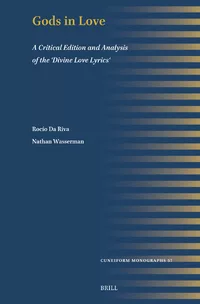
  • Gods in Love. A Critical Edition and Analysis of the ‘Divine Love Lyrics’

    Series: Cuneiform Monographs, Volume: 57 Authors: Rocío Da Riva and Nathan Wasserman The Divine Love Lyrics is a thematically cohesive collection of approximately 50 cuneiform texts from the 1st millennium BCE, originating in Assyria and Babylonia. These texts are connected to religious ceremonies in Babylon that revolved around the city’s principal deities: Marduk, his wife Zarpanitu, and his lover, Ištar of Babylon. Long recognized as a significant corpus in Assyriology, particularly through the pioneering work of W. G. Lambert, the Divine Love Lyrics have often been referenced in discussions of love, sexuality, and ritual in Mesopotamian culture. Yet, despite their importance, no comprehensive edition or detailed study of these complex and often enigmatic texts has been undertaken—until now. This book aims to fill that gap. By expanding the known corpus, clarifying its structure and themes, and providing a meticulous edition and translation of each tablet, it offers a thorough philological foundation for future research. The study deepens our understanding of this fascinating yet challenging body of texts, shedding new light on their literary, religious, and cultural significance within the later phases of ancient Mesopotamia. Copyright Year: 2025   E-Book (PDF) Availability: Published ISBN: 978-90-04-74159-1 Publication: 29 Sep 2025 EUR €139.36 EUR €134.00 excl. VAT   Hardback Availability: Not Yet Published ISBN: 978-90-04-74158-4 Publication: 02 Oct 2025 EUR €142.04 EUR €134.00 excl. VAT

  • Seminar: Studying Babylonian Rock Inscriptions: Historical Questions and Methodological Challenges

    Date: Friday, 24 October 2025 | Time: Starts at 15:00 | Venue: Join us at the Andreas Mouskos Auditorium, The Cyprus Institute | Speaker: Prof. Rocío Da Riva, Department of History and Archaeology, University of Barcelona. Abstract: From Babylon, at the heart of modern-day Iraq, the Neo-Babylonian Empire expanded across much of the Near East during the 7th and 6th centuries BCE. Though relatively short-lived, this empire generated a rich corpus of inscriptions that illustrate the relationship between the imperial heartland and its peripheral territories. This presentation will examine a remarkable subset of that evidence: the inscribed monuments commissioned by Kings Nebuchadnezzar (605-562 BC) and Nabonidus (556-539 BC) and located in the mountains of Lebanon and Jordan, respectively. These monuments, not only anchor Babylonian kingship in distant territories but also pose important methodological challenges for field-based epigraphy. Hence, this presentation will address both the methodological issues involved in studying inscriptions in the field and the historical implications of these extraordinary monuments, silent witnesses to the ancient grandeur of the Mesopotamian empires. About the Speaker: Born in Madrid, Da Riva studied in Ghent, Erlangen and Würzburg. She obtained her PhD at the University of Würzburg (2001), and is currently professor in the Department of History and Archaeology of the University of Barcelona. She has worked on cuneiform collections from several museums in Europe, North America and the Middle East. Her main research interests are: administrative and historical texts, political history and religious and literary texts from Babylonia, as well as cuneiform epigraphy, and she has published several articles and books on these topics. Da Riva has given lectures and seminars in universities and research centers around the world, and has been visiting researcher in several international institutions during stays of various lengths. Da Riva has been fellow of the DFG Kolleg-Forschungsgruppe “Rethinking Oriental Despotism” at the Freie Universität Berlin, visiting professor at the Venice International University and Professeur Invité at the Université Paris 1 Panthéon-Sorbonne. She has also taught courses at the Yarmouk University of Irbid and at the Universität Tübingen. At present she directs the archaeological study of the site of Sela, in Jordan, where she carries out research on Iron Age Edom.

  • Rocio Da Riva on Project RelNet: religious networks in Late Babylonia

    Wednesday at 14:00 GMT marks the December Annotation Stammtisch, which is running to coincide with the Linked Pasts programme. This time, we'll hear from Rocio Da Riva on the project RelNet: 3 December 14:00 GMT — Rocio Da Riva on Project RelNet: religious networks in Late Babylonia Using I millennium BCE Babylonian cuneiform ritual texts as sources and Nodegoat as a research platform, RelNet scrutinises sacred landscapes and the connections between Babylonian cult centres, analysing temple festivals, religious journeys and their participants and venues. While cuneiform texts offer infinite possibilities for this, they also present a series of issues and challenges related to both the nature of the sources and the methodology.

  • RelNet: cartografiant les xarxes religioses de la Babilònia antiga

    Un projecte de la Universitat de Barcelona analitza els viatges sagrats i les connexions entre temples per entendre la societat del primer mil·lenni aC. El projecte RelNet (PID2022-136740NB-I00), liderat per la professora Serra Húnter Rocío Da Riva a la Universitat de Barcelona, se centra en l’estudi de les xarxes religioses a la Babilònia de finals del primer mil·lenni abans de la nostra era. La iniciativa investiga com els moviments, els itineraris i els contactes entre diferents centres de culte configuraven un entramat complex de relacions en què la religió articulava la vida social, política i cultural. Llegir Notícia a Departament de Recerca i Universitats Gencat