Welcome
We shape light to see, measure and protect.
The Wavefront Engineering Group studies how the amplitude, phase, polarization and coherence of light can be designed, controlled and measured, and what becomes possible when they are. Our work runs from the fundamental physics of highly focused electromagnetic fields to practical technologies for three-dimensional imaging and optical security. We are a team of six people based at the Department of Applied Physics and the Institute of Nanoscience and Nanotechnology of the Universitat de Barcelona. We combine analytical theory, numerical modelling and laboratory experiments.
What we do
-
Light in the focal region. When a beam is focused with a high numerical aperture lens, the field becomes a fully three-dimensional vector object, with a strong longitudinal component, evanescent contributions and polarization that changes from point to point. We develop the theory and the numerical tools to describe these fields, and we build them in the laboratory: computer-generated holograms displayed on spatial light modulators let us sculpt the complex amplitude and polarization of a beam. Our work includes light needles, beams with prescribed polarization at any transverse plane, partially coherent focused fields, and depletion beams for super-resolution microscopy. We also develop phase-retrieval methods that recover the full vector field, including its longitudinal component, from simple intensity measurements.
-
Polarimetric imaging in three dimensions. Measuring polarization is difficult when light is scarce. We combine 3D integral imaging with polarimetry and photon-counting statistics to estimate the degree of polarization and Mueller matrices in photon-starved conditions, in both the visible and the long-wave infrared. We also work on digital holography, wavefront coding and the 3D imaging of microscopic objects held by acoustic or optical traps.
-
Optical security. Light can carry secrets and it can prove authenticity. We use machine learning and the polarimetric signatures of nanoparticle and thin-film structures to authenticate objects that are practically impossible to clone, from optical codes to pharmaceutical tablets. We also design encryption schemes that hide information in the axial structure and polarization of focused beams, and we analyse the weaknesses of existing optical cryptosystems.
Funding
Research funded by Ministerio de Ciencia e Innovación, Spain MCIN/AEI / 10.13039/501100011033
- Grant PID2025-170221NB-I00
- Grant PID2022-136796OB-I00
- Grant PID2019-104268GB-C22

News
2026
16 September 2026: New Paper [Focused fields].
Super-pupil beam engineering for enhanced confinement of azimuthally polarized depletion beams
12 May 2026: New Paper [3D imaging and holography].
11 February 2026: Conference proceedings [Other topics].
19th Workshop on Information Optics: WIO 2025
2025
8 August 2025: New paper [Optical security].
Roadmap on Optics and Photonics for Security and Encryption
1 August 2025: New Paper [Other Topics].
[PENGEOM – A general-purpose geometry package for Monte Carlo simulation of radiation transport in complex material structures (New Version Announcement)] (https://doi.org/10.1016/j.cpc.2025.109634)
28 January 2025: New Paper [Focused fields].
[Characterization of highly focused vector fields using phase retrieval: a practical guide] (https://doi.org/10.1364/AO.544562)
2024
14 February 2024: New Paper [Focused fields].
Analysis of the behavior of highly focused, radially coherent Dirichlet sources
2 January 2024: New Paper [3D imaging and holography].
3D integral imaging of acoustically trapped objects
2023
09-12 October 2023, Frontiers in Optics + Laser Science 2023, Tacoma (WA)
- Local Stokes Parameters: Description of Highly Focused Radially Polarized Fields with a Topological Charge by M. Aviñoá
14–17 August 2023, 3D Image Acquisition and Display: Technology, Perception and Applications 2023, Boston (MA), USA
- Integral Imaging Combined with Acoustic Trapping by K. Mohsenvand
28 June 2023: New Paper [Focused fields]. Local characterization of the polarization state of 3D electromagnetic fields: an alternative approach
20 January 2023: Kavan Ahmadi's thesis defense
2022
14 October 2022: New paper [Optical security]
Optical visual encryption using focused beams and convolutional neural networks
18-22 July 2022, V International Conference on Applications of Optics and Photonics (Guimarães, Portugal)
- 19 July: GUI-Based Phase Retrieval Algorithm for the Reconstruction of the Longitudinal Component of Electromagnetic Beams by M. Aviñoá
- 20 July: On the total estimation of the electromagnetic field in the focal area with no interaction with the media by D. Maluenda (Keynote)
- 20 July: Estimation of Zernike polynomials for a highly focused electromagnetic field using polarimetric mapping images and neural networks by K. Ahmadi
20 May 2022: New Paper [3D imaging and holography].
Estimation of Degree of Polarization in low light using truncated Poisson distribution
2021
13 October 2021: New Paper [3D imaging and holography].
Roadmap on digital holography [Invited]
9 September 2021: New Paper [Focused fields].
Experimental estimation of the longitudinal component of a highly focused electromagnetic field
27 August 2021: New Paper [Education].
Multi-spectral imaging: a tool for the study of the area burned in wildfires
30 July 2021: New paper [Focused fields].
Efficient calculation of highly focused electromagnetic Schell-model beams
19 -23 July 2021: OSA Imaging and Applied Optics Congress (OSA Virtual Event).
- 21 July: 3D Degree of Polarization and its Fundamental Limits by M. Aviñoa
- 21 July: Fast Mapping of Double-Pixel Holograms using K-Nearest Neighbors by K. Ahmadi
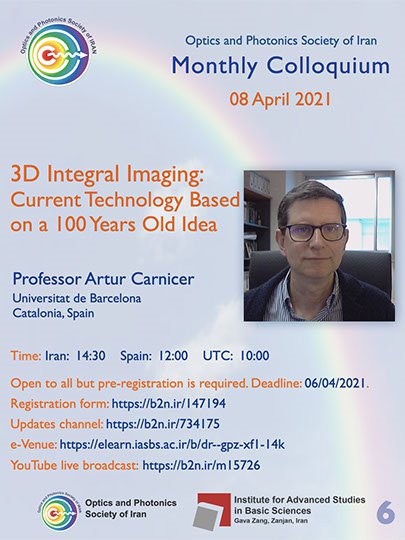
8 April 2021: OPSI-IASBS colloquium,
5 April 2021: New paper [Other collaborations].

This work is licensed under a Creative Commons Attribution 4.0 International License.
Last Updated: 30 October 2026