
POSTGRADUATE PROGRAMME IN LEARNING SPACES DESIGN
(eighth edition)
INTRODUCTION
The Postgraduate Programme in Learning Space Design is a pioneering and innovative programme that responds to the need to improve spaces in educational institutions. This improvement can, in turn, act as a driver of innovation for the pedagogical projects of schools at any educational stage.
The postgraduate programme is based on the progress made in the field of education and the emergence of new pedagogical proposals and strategies. It also focuses on research into the changes that educational spaces should undergo through a threefold approach: the configuration and organisation of the learning space; the conditions, dynamics and methodologies developed within these spaces; and the appropriation of digital tools and environments in relation to space and learning.
The postgraduate programme offers professional training based on active learning and grounded in the rigour of scientific and applied knowledge. Graduates of this programme will acquire the skills and knowledge needed to design, implement and evaluate educational spaces, taking into account the environmental, pedagogical and digital dimensions. The knowledge acquired can be applied to any learning context, whether formal or non-formal.
TARGET AUDIENCE
University graduates who wish to specialise in the design of educational spaces, from fields such as education, design, architecture, educational management or other related areas.
This programme also allows for the possibility of admitting students who do not hold a university degree, who may opt to obtain a university extension certificate.
OBJECTIVES
· Develop the skills to design, implement and evaluate learning spaces
· Learn strategies and how to manage tools and resources to intervene in spaces from a threefold perspective: pedagogical, environmental and digital
Specific objectives
-
Learn the fundamental principles of human-centred design applied to educational environments and wellbeing
-
Understand and analyse different pedagogical and architectural trends related to innovation in educational spaces
-
Understand and analyse the main research on the influence of spaces on learning
-
Understand and apply in depth the principles of educational space design
-
Explore current trends in furniture, resources and the configuration of spaces
-
Analyse, from the digital dimension, the most suitable configuration of digital resources for an educational space
-
Understand and apply design thinking to the conceptualisation of educational spaces
-
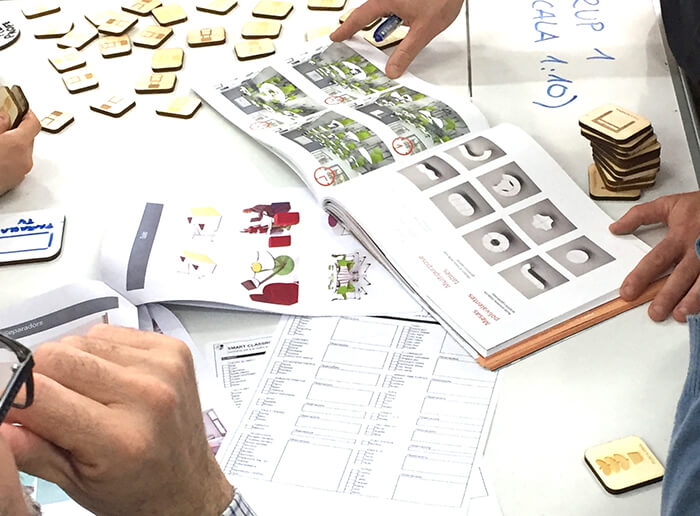
Design an educational space that responds to a specific pedagogical project through participation in a co-design process with the educational community
COMPETENCES
Knowledge of the fundamental principles of human-centred design applied to educational environments and wellbeing
Knowledge of the different pedagogical and architectural trends related to innovation in educational spaces
Knowledge of the main research on the influence of spaces on learning
Knowledge of current trends in furniture, resources and the configuration of spaces
Application of educational space design principles
Ability to analyse, from the digital dimension, the most suitable configuration of digital resources in an educational space
Knowledge and ability to apply design thinking to the conceptualisation of educational spaces
Apply knowledge and skills to the design of an educational space that responds to a specific pedagogical project through participation in a co-design process with the educational community
MODULES
Module 1. Co-design of learning spaces
This module introduces co-design as a participatory approach to creating learning spaces aligned with pedagogy, moving beyond traditional expert-centred design. It analyses space as an educational agent and highlights the importance of involving the entire community: students, teachers, families and institutions. It also develops the process through design thinking —empathy, ideation, prototyping and evaluation—, emphasising continuous improvement, experimentation and the sustainability of design.
Module 2. Learning and educational space
This module analyses the relationship between learning and educational space, showing its evolution from a transmission-based model to ecosystems that influence wellbeing and inclusion. It reviews pedagogical movements such as Montessori, Reggio Emilia and Escuela Nueva, as well as the spatial translation of these approaches. It also presents current models based on flexibility and diversity of scenarios, highlighting the need to align pedagogy and space in order to promote active, collaborative and meaningful learning.
Module 3. Dimensions and principles for designing learning spaces
This module analyses the pedagogical, environmental and digital dimensions involved in designing learning spaces that are coherent with educational objectives. It explains how space influences wellbeing and learning, and proposes principles such as flexibility, adaptability, comfort, connectivity and sustainability. The module provides criteria for evaluating and designing educational environments as comprehensive systems that foster inclusion, participation and meaningful learning experiences.
Module 4. Design of other educational spaces: outdoor areas, libraries, STEAM classrooms, dining areas and other common spaces
This module addresses the design of non-formal educational spaces such as playgrounds, libraries, STEAM classrooms, dining areas and common spaces, understanding them as key learning environments. It proposes transforming these spaces into inclusive, flexible pedagogical ecosystems oriented towards wellbeing, socialisation and creativity. Principles such as zoning, biophilia, flexibility and experiential learning are analysed, highlighting their impact on coexistence, identity and the holistic development of students.
Module 5. Integration of technology for learning in educational spaces
This module addresses the integration of digital technology into educational spaces from a systemic perspective, highlighting that its impact depends on the coherence between pedagogy, space and technology. It analyses the classroom as a techno-pedagogical ecosystem and reviews the limitations of the traditional digitalised model. It also presents principles such as invisible technology, connectivity and flexibility, together with types of spaces and strategies aimed at fostering active, collaborative and meaningful learning.
Module 6. Learning spaces and diversity
This module addresses the design of learning spaces from an inclusive perspective, integrating legal, technical and social aspects. It analyses how architecture and design can act as instruments for inclusion, taking into account functional, cognitive and cultural diversity, as well as the gender perspective. It also explores inclusive design in physical and digital environments, highlighting the importance of removing access barriers and involving users in the process in order to create accessible, equitable and people-centred spaces.
Final module. Final Postgraduate Project (FPP)
In this module, you will develop the final postgraduate project, which consists of designing a learning space in a real context. A tutor will support you throughout the entire development of the project.
METHODOLOGY
The postgraduate learning proposal combines different methodologies, mainly active learning, based on case analysis and the development of a final project. The core element is the student’s learning activity, especially the final project, which will be developed individually throughout the course. This project is linked to a real context involving the design of a learning space, according to each student’s possibilities and interests, and culminates in the development of the Final Postgraduate Project.
To achieve this, the teaching team proposes a guided pathway with different dynamics and activities that will progressively enrich the project. These activities are varied: presentations and analysis of theories and national and international research reports, debates around audiovisual materials and specialised readings, expert lectures, presentations and analysis of real cases and experiences, collaborative problem-solving around specific learning spaces, visits to schools, both in person and through 360º virtual reality, small-group follow-up seminars, and more. All activities are carried out through the postgraduate programme’s virtual campus. As an element that provides significant added value, meetings are held during the course with partner centres that are benchmarks in the design of learning spaces.
Assessment is continuous and is based on the personal and group support provided by the teaching team regarding each student’s work and progress. The progressive development of the Final Postgraduate Project and its defence before an academic committee are the key elements of the final grade for the postgraduate programme.
MORE INFORMATION
Awarded qualification: Postgraduate Diploma from the University of Barcelona
Duration: 1 academic year, from 14/10/2026 to 09/06/2027
Number of credits: 30 (750 hours)
Format: Online
Language: english
Pre-registration: Open
Price: 2.200€. The amount is subject to a 10% increase, up to a maximum of €70, as an administrative fee
Contact: posgradodea@ub.edu
TEACHING STAFF
Collaborating expert lecturers

Guillermo Bautista Pérez (Coordinator)
gbautista@ub.edu
More information
Postgraduate programme coordinator.
PhD in Pedagogy. Professor of Psychology and Education Sciences at the Universitat Oberta de Catalunya and Associate Professor at the Faculty of Education of the University of Barcelona. Principal Investigator of the Smart Classroom Project at the Universitat Oberta de Catalunya and of the Learning Environments and Materials research group, recognised by the Government of Catalonia. Member of the Institute for Research in Education at the University of Barcelona.

Mikel Manzanos Tirador (Lecturer)
More information
Graduate in Industrial Design Engineering and Product Development from Mondragon University. Postgraduate Diploma in Learning Space Design from the University of Barcelona and Master’s Degree in UX/UI Design from the European University of Madrid. Author of a study on the co-design of educational spaces. He has participated in research projects on inclusive educational environments and the impact of spatial design on learning. Collaborator with Smart Classroom Project.

Leticia Navarro Julián (Lecturer)
More information
Pedagogue and educational psychologist. Lecturer and supervisor of Bachelor’s and Master’s final projects at the International University of La Rioja, and teacher in vocational training programmes in Early Childhood Education and Social Integration. She holds a degree in Pedagogy from the University of Barcelona and a Master’s degree in Educational Psychology. Author of the book El entorno y la estética en el aprendizaje. Specialised in the Reggio Emilia approach, she has developed her career in the fields of education and educational psychology guidance.

Sònia Giménez Canal (Lecturer)
More information
Director of Escola Lola Anglada, with extensive experience in current educational transformation processes. She holds a teaching diploma and a Master’s degree in Educational Psychology. She is a lecturer at the Universitat Oberta de Catalunya, teaching on the Bachelor’s Degree in Primary Education and the Master’s Degree in Educational Psychology. She has significant experience leading pedagogical change processes, not only as a school director, but also as a facilitator at the Educational Transformation Laboratory, where she supports other schools in creating modern, functional learning environments aligned with new methodologies.

Juan Negreira Montero (Collaborating expert)
More information
PhD in Engineering from Lund University, Sweden. He was a full-time lecturer and researcher at this university for 10 years and currently remains affiliated as an associate professor. He is an expert in acoustics and space design, with a focus on the impact of sound comfort on wellbeing and pedagogical performance. His work combines his professional career at Saint-Gobain Ecophon with teaching at Lund University and La Salle University. With a PhD in vibroacoustic engineering, he combines academic research with the development of sustainable solutions for educational infrastructure.

María Casanovas Vayo (Collaborating expert)
More information
Teacher and co-director in primary and secondary educational contexts focused on methodological and spatial innovation at an international level. She has experience in applied research on new educational tools and spaces for personalised learning. Research assistant in the Smart Classroom Project group.

Marta López Costa (Col·laboradora experta)
More information
Professor in the Faculty of Psychology and Education Sciences at the Universitat Oberta de Catalunya and principal investigator of the GREDU group. Her research focuses on the design of teaching and learning processes with digital technologies, as well as on educational innovation and the design of learning spaces. She has participated in research and consultancy projects at national and international level and has published in leading academic journals.

Andrés Martínez Banda (Collaborating expert)
More information
Engineering graduate from DTU, Denmark, and expert at Ecophon, Andrés Martínez Banda specialises in optimising the acoustics of educational spaces to maximise communication and cognitive performance. He currently works as a Concept Developer at Saint-Gobain Ecophon Spain. His work focuses on acoustic engineering and the development of concepts to improve sound environments. At Saint-Gobain Ecophon, he shares knowledge and experience on acoustic solutions, especially those focused on the educational sector.

Paula Cardenillo (Col·laboradora experta)
More information
Architect, researcher and lecturer specialised in the design of innovative educational spaces. She holds a PhD in Architecture and Urban Planning from the Universidad del Bío-Bío, Chile, 2016, and a Master’s degree in Intelligent Buildings. She carries out her academic work at the Faculty of Architecture of Universidad ORT Uruguay, where she leads international projects and seminars on the relationship between architecture, pedagogy and technology.
She is an advisor on educational infrastructure for Uruguay’s National Administration of Public Education, ANEP. She has participated in research projects focused on how spatial design influences educational practices in England, Chile and Uruguay, funded by ANII and the Teachers’ Fund of Finland, among others. She has been a speaker at international forums such as EnlightED and the Forbes Real Estate Summit.

Santiago Atrio Cerezo (Collaborating expert)
More information
Architect and PhD in Education Sciences, Dean of the Faculty of Teacher Training and Education at the Universidad Autónoma de Madrid, UAM. Since June 2022, he has been Director of the IUCE. He has held several academic positions, including Vice-Dean for Academic Organisation and Degree Programme Development and Director of the EducAcción Chair at UAM.
His main line of research focuses on analysing the interrelationship between architectural spaces, pedagogy and school culture, with particular attention to the creation of environments that promote educational innovation. He is the founder and current director of the School of Educational Architecture at UAM.

Raquel Colacios Parra (Col·laboradora experta)
More information
Architect with a PhD and researcher at TURBA Lab, an interdisciplinary research centre on social and cultural transformations, TRÀNSIC, at the Universitat Oberta de Catalunya, UOC. Her research examines architectural and urban design as instruments for promoting social and environmental justice. She specialises in the interrelationship between climate-sensitive and sensory-friendly urban strategies.
Her work critically analyses co-creation as a methodological and epistemological framework, exploring how to structure participatory processes that include those who are excluded from urban decision-making. Through interdisciplinary research, she contributes to the development of inclusive and resilient urban environments.

Victoria Morin Fraile (Col·laboradora experta)
More information
Professor at the Faculty of Nursing of the University of Barcelona. Researcher in education, health promotion and health literacy, as well as in service-learning, understood as educational practices that empower university students and citizens to commit to improving health and wellbeing in society.

Silvia Guillamot Mañé (Collaborating expert)
More information
Graduate in Teaching, with specific training in school leadership and management. Director of several educational centres. Founding director of Escola Norai, a benchmark school in educational spaces. She has experience in school management and pedagogical innovation. She specialised in Learning Space Design through the postgraduate programme at the University of Barcelona. She is currently a training specialist at the Universitat Autònoma de Barcelona and an associate professor at the same university.

Xavier López i Ortín (Collaborating expert)
More information
Graduate in Primary Education, with an official Master’s Degree in Research in Didactics, Teacher Training and Educational Assessment from the University of Barcelona, and a postgraduate qualification in the Management of Educational Centres and Services from the University of Girona. He is an educator, teacher and trainer with a recognised profile in the field of pedagogical renewal and educational leadership in Catalonia. He was Director of Escola Octavio Paz in Barcelona for eight years, where he led a pedagogical transformation over eight academic years that was recognised with the Agenda 2030 Award. He specialises in active methodologies, teacher support and emotional wellbeing. He is Director of CRP V Baix Llobregat and the author of several books on education.

Sara Sotorra Gil (Col·laboradora experta)
More information
Diploma holder in Primary Education Teaching (2007), with extensive experience in school management and organisation. At Escola Marcel·lí Moragas, she worked as cycle coordinator (2009-2010) and ICT coordinator (2011-2015). Since joining Escola Miquel Martí i Pol in September 2015, she has consolidated her management career by taking on cycle coordination for five consecutive academic years (2017-2022), until reaching her current position as head of studies for the 2024-2025 academic year.

Ana Vicalvaro (Col·laboradora experta)
More information
Director of Escola Octavio Paz in Barcelona. Early Childhood and Primary Education teacher, specialising in English language teaching. She is committed to pedagogical innovation and the transformation of educational spaces, with a particular interest in learning space design as a tool to foster active methodologies and educational wellbeing.
STUDENT VOICES
CONTACT