
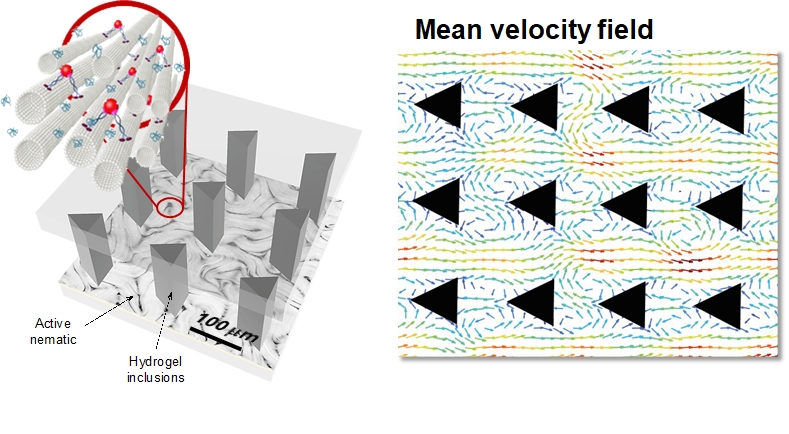
Lab-on-a-chip systems enable the simultaneous analysis of multiple chemical samples and the execution of intricate in situ microfabrication within a single integrated platform, where fluids are driven and regulated at submillimeter dimensions. Although such devices usually depend on external power inputs, this work led by Prof. Jordi Ingés, Self-organized complexity and self-assembling materials (SOC&SAM) published at PNAS, presents an alternative approach based on active fluids: liquids made of self-driven constituents that typically generate chaotic flow fields. In this work, researchers employ an active nematic fluid into which they incorporate arrays of triangular hydrogel microcolumns. These structures reorganize the intrinsic turbulence into well-defined flow patterns, thereby exploiting the fluid’s internal activity and giving rise to active pumping elements. These pumps can be freely arranged to modulate pressure or flow rate from within, offering a fully internalized mechanism for control in microfluidic architectures.
Active nematic pumps. Vélez-Cerón, I.; Coelho, R.C.V.; Guillamat, P.; Vergés-Vilarrubia, M.; Telo da Gama, M.; Sagués, F.; Ignés-Mullol, J. Proceedings of the National Academy of Sciences of the United States of America (PNAS). November 12, 2025, 122 (46) e2427103122.