Description
Quantity of renewable energies (currently, only photovoltaic energy), produced at the University of Barcelona facilities.
| Indicator | 2020 | 2021 | 2022 | 2023 | 2024 | Evolution |
|---|---|---|---|---|---|---|
| Photovoltaic production (kWh) | 27.609 | 23.607 | 22.796 | 110.359 | 497.074 |  |
| Estalvi CO₂ equivalent (tones) | 6,90 | 6,11 | 6,22 | 28,69 | 129,24 | |
Results
Our society depends on non-renewable sources of energy, mostly fossil fuels such as oil, natural gas and coal, for its energy supply.
Various measures can be taken to reduce the negative environmental impacts generated by the consumption of this type of energy. On the one hand, it is possible to reduce consumption by improving energy efficiency.
Another way to improve the environment, which is becoming increasingly common in public institutions, private companies and even in households, is the use of renewable energy sources, either by contracting the energy consumed from renewable sources or through own production facilities.
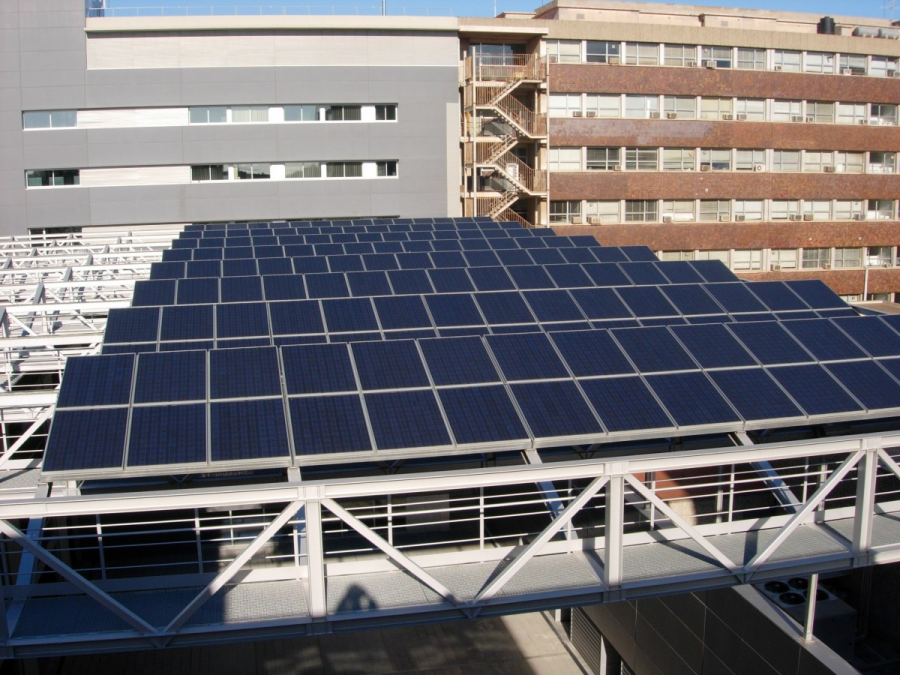
Since 1 January 2018, the UB has contracted the electricity it consumes from renewable sources. Long before that, in 2004, the UB joined in the promotion of low-carbon energies, participating in an inter-university project with a 500 m² photovoltaic installation in the faculties of Physics and Chemistry, capable of producing electricity equivalent to the annual consumption of around 30 homes.
The UB’s photovoltaic production was maintained exclusively with the Atri Solar until 2023, when new self-consumption installations were started up on the roofs of various buildings: the Faculty of Economics and Business, Bellvitge Campus, the faculties of Philosophy and Geography and History, and the Ponent and Migdia I buildings on the Mundet Campus. With these installations, electricity generation at the UB will increase to almost 500 MWh by 2024.
Charts
