

News & Events

2025 year in review
As 2025 winds down, it’s the perfect moment to look back at this year’s outputs and events coming out from the project. Missed it? You can now catch up: A public version of the microsimulation model is now available. We launched our public consultation on Lifecycle Notional Accounts Publications Around the world Wishing everyone a happy holidays!

The cost of parenthood: Men with children spend an extra hour on household chores
Last month, results from this paper Lifecycle analysis of the gender gap in paid and unpaid work by household structure were featured in the Spanish newspaper, La Vanguardia. When comparing couples with and without children, it is observed that the former work longer hours than the latter: an average of 14.7 hours per day compared…

How Ageing and Migration Affect European Economies: An Analysis Using European National Transfer Accounts
On 19-21 November 2025, Bernhard Binder-Hammer from the Vienna Institute of Demography (OEAW) team presented this poster at the Wittgenstein Centre Conference on Demographic Perspectives on Migration in the 21st Century

Lifecycle Notional Accounts: Policy workshop for an integrated view of welfare policies along the lifecycle
On 13 November, the SUSTAINWELL Horizon Europe funded project, led by Prof. Ció Patxot from the Barcelona Economics Analysis Team (BEAT), organised an on-line policy panel discussion on the design of a new perspective of the welfare policies throughout the lifecycle. The session was chaired by Dr Nicole Mum Sim Lai, Economist at the UN Department of Economic and Social Affairs. The panel consisted of Ms Anna…
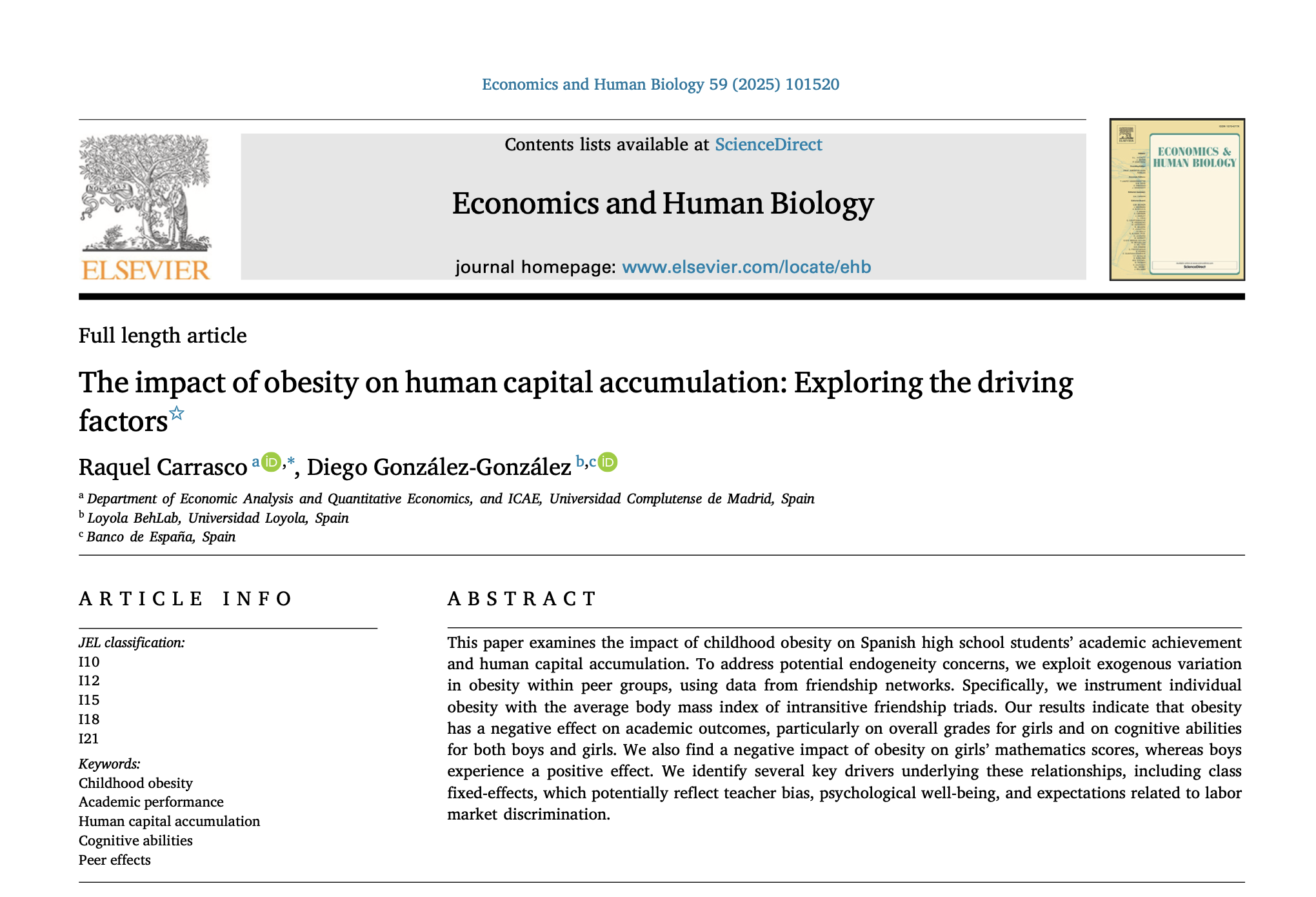
The impact of obesity on human capital accumulation: Exploring the driving factors
Abstract This paper examines the impact of childhood obesity on Spanish high school students’ academic achievement and human capital accumulation. To address potential endogeneity concerns, we exploit exogenous variation in obesity within peer groups, using data from friendship networks. Specifically, we instrument individual obesity with the average body mass index of intransitive friendship triads. Our…

NEW OPEN ACCESS PUBLICATION
Lifecycle analysis of the gender gap in paid and unpaid work by household structure Abstract The paper provides new insights into men and women’s lifetime contributions to the overall economy and societal well-being, taking both market and non-market activities into account. It extends the National Transfer Accounts (NTA) and National Time Transfer Accounts (NTTA) methodologies…

The Impact of Ageing, Socio-economic Differences and the Evolution of Morbidity on Future Health Expenditure – a Dynamic Microsimulation
Researchers from the WIFO team have released a new publication about the impact of population ageing on healthcare expenditure. They use dynamic microsimulation to project healthcare expenditure in Austria and disentangle the effects of changes in longevity, population age-structure, healthy life years and socio-economic health disparities. By combining price weights for healthcare services with information…

Policy Roundtable on Mongolia’s Generational and Gendered Economy
Our coordinator, Ció Patxot, participated this week in the “Advancing Equity and Inclusion: A High-Level Policy Roundtable on Mongolia’s Generational and Gendered Economy” event hosted by UNFPA Mongolia. The meeting focused on demographic shifts and the use of National Transfer Accounts (NTA) data for policy-making, with presentations from experts discussing the economic contributions of different…

External Effects of the Pension System in the Context of the Welfare State
This paper provides results from different studies conducted by the Gemma Abio, Ció Patxot (UB) and Guadalupe Souto (UAB) and other authors aiming at measuring the external effects generated by the existence of an intergenerational transfer system, such as the pension system, and the welfare state as a whole. The primary reason for the presence…

Microdata in Macromodels
Martin Spielauer and Philipp Warum from WIFO participated in the MacroABM 2nd Workshop last 29-30 April celebrated at Vienna University of Economics and Business (WU). The workshop brought together researchers from diverse modelling perspectives, including ABM, HANK, and microsimulations, to encourage collaboration across currently disconnected fields and explore challenges and innovative solutions in using microdata…

International Odyssey Conference on Economics and Business
University of Ljubljana researchers participated in the 16th International Odyssey Conference on Economics and Business celebrated in Dubrovnik (Coatia) from 7th to 10th May 2025, organised by the Faculty of Economics and Business (University of Zagreb, Croatia). The Conference gathers together researchers and practitioners to discuss about the latest challenges in the field of business…

Doing better for families
Held annually on 15th May, the International Day of Families (IDF) was established by the United Nations (UN) in 1993 (A/RES/47/237) to raise awareness among policymakers, experts and the general public of the problems and needs faced by families around the world and of effective ways of meeting those needs. This year, the UN highlights the vital role…