In this article, we briefly explain a Socio-Sports Meeting, developing its structure in 10 steps with examples of games, challenges and cooperative dynamics to promote the social inclusion of people in a situation of social exclusion or at risk of social exclusion.
The Socio-Sports Meetings are based on a methodology developed at the University of Barcelona since 1993.
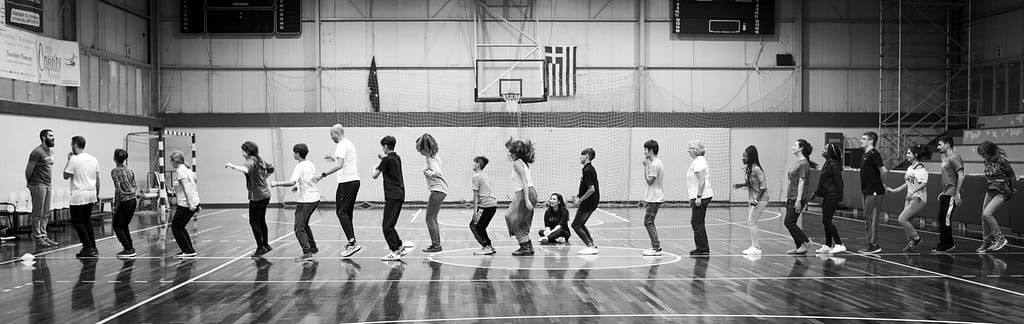
Socio-Sports Meetings
The Socio-Sports Meetings of the University of Barcelona use physical activity as a tool to promote social inclusion and facilitate the physical and psychological well-being of people in a situation of exclusion or at risk of exclusion.
The methodology of this socio-educational intervention focuses on group games and cooperative challenges in which the participants must collaborate to achieve the objective. These physical activities put competitiveness aside to foster positive and healthy bonds.
Each Socio-Sports Meeting is designed by selecting the most appropriate games and challenges according to the number of people and their needs so that everyone can participate and enjoy the activity in an inclusive way. This type of intervention is carried out by professionals working in social work, education, pedagogy, psychology or sports.
In this training session, we present an example of a Socio-Sports Meeting, including its structure and some driving proposals. However, these meetings have many more games and challenges than this example, given that they last approximately two to three hours. We have simplified it so that this article is not too long.
In subsequent articles on this blog, we will show more of these motor-skill proposals until we reach the 80 contained in the practical guide that we are preparing for professionals who want to implement Socio-Sports Meetings.

Structure of a Socio-Sports Meeting
Though the structure of a session may vary depending on its implementation, we propose the following session structure to facilitate its development for the facilitating group and the participants.
The rituals and games, which usually go from the beginning to the closing ritual, usually last between 1.5 and 2 hours.
1. Reception
During the time allocated for the reception, two people representing each group welcome the people who participate in the Meeting.
The groups in our case are refugees and university students, but this type of socio-educational intervention can be carried out with other groups in a situation of social exclusion or who are at risk of social exclusion and other groups in their community.
2. Starting ritual
To begin the session, a starting ritual is carried out so that the participants can begin to get to know each other. For this example we have chosen “The Wave of Names”.
The Wave of Names
- Type: Starting ritual and identification game
- Material: None
- Description:
The group forms a large circle. Each person says their name and what they like most. This can be anything: sports, food, hobbies…
After doing so, the person must walk around the circle, running and high-fiving all the other participants.
The rest give the person encouragement. When the person returns to their place, the next person does the same, and so on until all the people in the group have done so.
3. Identification games
This type of game aims to get the participating people to know each other a little better, learning their names or knowing some details about their personalities. For the example, we have chosen a memory game about names.
Let’s remember!
- Type: Identification game
- Material: None
- Description:
Groups of between six and 10 people are formed. Each group stands in a circle with the others.
One person starts the game by saying their name. The person to their right follows, saying the name of the previous person and their own name.
This goes on until the last person says the names of all the classmates, from the first to their own. - Variation: Let’s pack the backpack
This variation follows the same dynamic as before, except it includes an imaginary backpack to do an activity like going to the beach, on a hike or any other activity we can think of.
You start the game by saying the name and an object that you put in the imaginary backpack. This involves repeating the names of the people and the object in a chain. This variation adds a little more difficulty. - Observations: If someone does not remember a name or makes a mistake, the other participants will help them to remember it together.

4. Group games
Now that people know each other a little better, it’s time to start playing and doing physical exercise. Three to five collective games are enough for a session in which cooperative challenges will also be carried out.
However, the structure of the Socio-Sports Meeting can be modified to contain more games and fewer challenges at the discretion of the professional, according to the needs of the group. In this example, we are going to show a single game. We will publish more in future articles.
The spell
- Type: Group game
- Material: Bibs or balls
- Description:
There are two types of participants in this game: the pursuers and the pursued. The pursuers wear a bib or carry a ball so they can be identified and they are the magical people.
When a magical person catches someone in the group, they freeze and turn them into a statue, who must stay still in place.
Each frozen person can represent the statue they prefer and can move again when a person who has not been caught imitates their posture exactly. - Variation:
You can use other practices to free the people who have been turned into statues:
– High-fiving each other.
– Doing a dance together (in front of each other).
– Singing together.
– Greeting each other in a fun way. - Observations:
The number of magical people must be well calibrated so that the game is dynamic and everyone enjoys participating in it. For example, for a group of 20 people it may be appropriate for between four and five to have the role of magical people. The dynamics of the game must also be observed carefully to identify when the time comes to change roles.
5. Cooperative challenges
When the group games are over, the cooperative challenges begin. People must help each other, contribute ideas and communicate to achieve the objectives of these cooperative challenges.
Groups of five to eight people must be formed to carry out the cooperative challenges. The groups can put them into practice autonomously and, once they have achieved a challenge, move on to the next. Therefore, there must be more challenges than groups so they can all solve different challenges at the same time and always have the option of finding another one available.
In this example, we are going to show a single challenge. We will publish more in future articles.
Superman
- Type: Cooperative challenge
- Material: At least one thick safety mat
- Description:
A mat allows us to fly! We will have to transport the participants from one place to another on the ground without them touching the ground. Use the thick safety mat and do it as if the person had jumped into a pool like Superman. - Rules:
1. All participants must fly at the same time. No one can stay off the mat when it moves.
2. They can only use the mat to move forward.
3. Everyone must jump on the mat at the same time. - Variation: Hold hands throughout the process.
- Observations: Make sure the floor is smooth enough for the mat to slide across it.
6. Cool-down games
After exercising, a low-intensity game is played so that the participants return to a state of rest.
Photograph
- Type: Cool-down game
- Material: None
- Description:
Two people are the photographers and the rest of the group poses motionless to be photographed. The photographers have one minute to observe and try to remember the positions of all the people in the group.
After the minute of observation, the photographers turn their backs to the group and stop observing. Then the group can make five changes: positions between people, postures, adding or removing objects from the photo, facial expressions, etc.
Finally, the photographers observe the group again and must discover and correct the changes that have been made in relation to the initial photograph. - Observations: You can vary the people playing the role of photographers (no matter how many there may be). You can also decrease or increase the observation time for the initial photograph.

7. Closing ritual
A symbolic farewell activity concludes the Socio-Sports Meeting, an energetic gesture aimed at strengthening the feeling of belonging to the group and jointly celebrating the team bond forged between the participants.
Group shout
- Type: Closing ritual
- Material: None
- Description:
This is a dynamic that does not take much time aimed at jointly sending a final message. Everyone who has participated in the Socio-Sports Meeting decides on a motto that they will shout in unison to end it. To do this, they stand in a circle and hold hands or place their hands on each other’s shoulders, creating a large united group. The countdown begins and at the end everyone shouts the chosen motto together.
If there are many participants, you can make an outside circle and smaller ones within it.
8. Evaluation and end
When the motor-skill games are over and the group’s relationships are more fluid, the participants commonly assess the Meeting. This is a relaxed moment where they can express their feelings about the experience. Its duration depends on the number of people participating, but 15 to 30 minutes is usually enough.
There are different approaches to do so that we will post on this blog in the future. For this example, we have chosen “One Word”.
A word
- Type: Dynamic of close and evaluation
- Material: None
- Description:
In a circle, each person thinks of a word to define the Socio-Sports Meeting and shares it with the others, one by one. - Variation:
Prominent situation. Each participant reflects on a situation that has been important for them. People who want to share it with the group will do so.
9. Preparation for the next session
Next, work begins to design the next session, distributing the roles of facilitator of the games and leadership of the session among the university students and the people in a situation of social exclusion or who are at risk of social exclusion.
Everyone involved in the session can participate in planning and proposing activities for the next session. They can propose changes, improvements or new games.
This methodology ensures that all participants (students, sector professionals and refugees) are involved in the process and become active agents providing additional information about the teaching and learning process during the preparation, development and evaluation of Socio-sports Meetings.
10. Snack
The Meeting ends with the snack or refreshment, which usually lasts between 30 and 60 minutes. It is an informal picnic with food and drinks where participants can chat in a relaxed manner and get to know each other better.
This has indisputable value for the development of social and communication skills of both groups (refugees or asylum seekers and university students, in our case).


