
The UB inaugurates IPERC: an international academic dialogue to address the challenges of democracy
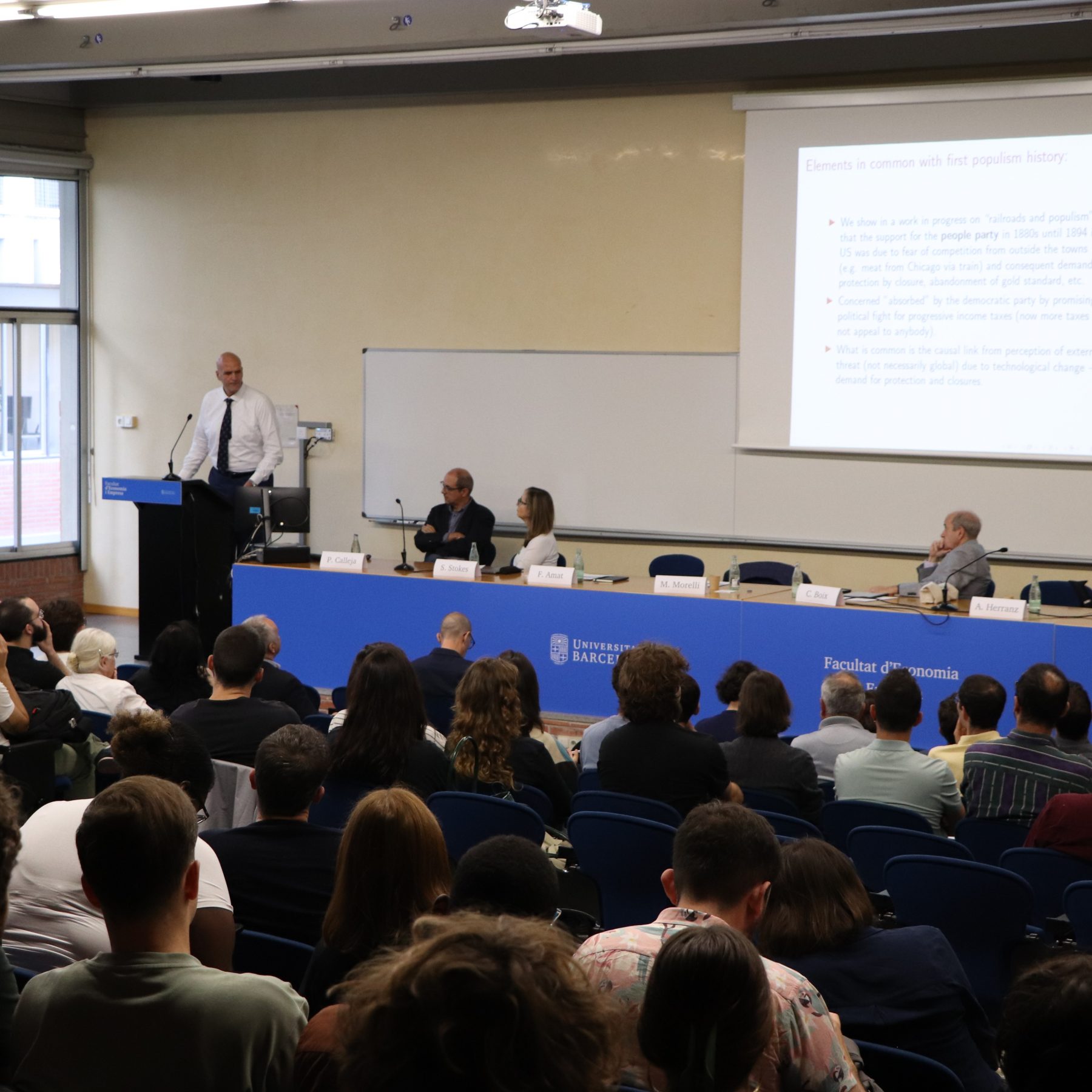 The UB School of Economics at the University of Barcelona hosted the inauguration of the new Research Centre on Institutions, Politics and Economics (IPERC), a centre that aspires to become a global benchmark in these research fields. The opening round table, “The Current State of Democracies: Challenges and Future Paths”, brought together three internationally renowned academics: Susan Stokes (University of Chicago), Massimo Morelli (Bocconi University), and Carles Boix (UB and Princeton University).
Professor Stokes focused her speech on the contents of her latest book, The Backsliders: Why Leaders Undermine Their Own Democracies. According to the author, the democratic decline of recent years cannot be explained by coups d’état, but rather by the internal erosion of institutions. “Since the 1980s, military coups have declined, but authoritarian policies that undermine democracy have increased,” she said. For Stokes, this institutional degradation has structural causes, such as “globalization, which has accentuated inequalities and weakened public confidence in institutions,” as well as the shift of the left towards more urban and educated voters. Among the solutions proposed, she advocated strengthening civil society and professional associations, and the need to “create cordons sanitaires around both ethnonationalism and left-wing populism”.
Professor Morelli gave the talk “Populism: from protection to exclusion and regression”. After acknowledging that populism stems from a “legitimate demand for protection”, he warned that this trend has degenerated into exclusionary and regressive movements. “The enemy is not populism itself, but the nationalism that often accompanies it,” he stressed. To combat this dynamic, he proposed calling for a “stronger and more popular” Europe that can control global economic powers, and advocated measures such as the creation of a European army with unified command, elections with real competition to elect the European government, and the promotion of a common European identity.
Finally, Professor Carles Boix addressed the relationship between capitalism and democracy with his talk “Democratic capitalism: under attack?”. Boix offered a historical overview of the evolution of capitalist democracies from the 19th century to the present day, questioning the theories that point to an inevitable decline in democracy. According to him, “democracy does not regress in countries where there is greater prosperity and wealth,” and the key to preserving it is to find “the right balance between inequalities and the mechanisms that moderate them.” Boix argued that the current challenge involves ensuring an inclusive capitalism that generates democratic stability.
Carles Boix, scientific director of IPERC, is an international academic leader in political science and political economy, a professor at Princeton University and a researcher at the UB. A Harvard PhD, he is renowned for his pioneering research on the foundations of democracy, wealth distribution, political institutions and the relationship between economic development and systems of government. Author of influential books such as Democracy and Redistribution, Political Order and Inequality, Partidos políticos, crecimiento e igualdad, and Cartes ianquis, Boix has been awarded several international prizes and is a member of the American Academy of Arts and Sciences. His profile combines comparative rigour, impact on the debate on Catalan nationalism, and a commitment to dialogue between academic research and social transformation.
IPERC is a new interdisciplinary research centre at the UB whose aim is to analyse the role of political institutions in long-term economic change processes. Created through collaboration between three established UB research groups in political science, economic history and political economy, the centre aims to establish itself as an international benchmark in the study of global challenges such as the climate crisis, inequality and democratic erosion. The organization seeks to promote competitive research, academic activities and knowledge transfer projects, contributing to strengthening the internationalization and scientific projection of the UB in the field of social sciences.
Recent news
- Structural change reshapes urban expansion: new research published in the Review of Economic Studies
- The University of Barcelona to host the 38th Annual Conference of the European Association of Labour Economists (EALE)
- UB School of Economics Researchers join new Council for Productivity and Economic Leadership in Catalonia
- Conference with Gabriel Oddone, UB Alumnus and Minister of Economy and Finance of Uruguay
- Our researcher Javier Vázquez-Grenno has been awarded one of the research grants from the Social Observatory of the 'la Caixa' Foundation
- Call for expressions of interest for Postdoctoral and Assistant Professor positions
- A Closer Look at the MSc in Economics Class of 2027
- Six researchers of the UB School of Economics are listed in the 2% of the world’s most influential scientists
- The UB inaugurates IPERC: an international academic dialogue to address the challenges of democracy
Sorry, the comment form is closed at this time.